Category Archives: Uncategorized

Day 4 – Five Odd Questions About Poultry

I like Holly Spangler’s idea of posting short lists… so today’s post is a list of five questions we’ve been asked about our eggs and poultry.

1. Do you need a rooster for your hens to lay eggs?

We get asked this question all the time, so in case you have been wondering but were too shy to ask, the answer is no. Hens happily lay eggs even when there is no rooster around. If you want your eggs to hatch out chicks, that’s a different matter.

Chicken Eggs

Most grocery store eggs are either brown or white, but chicken eggs come in a range of colours. We find eggs that are pale blue, green, creamy-coloured, dark brown, pale brown, speckled, and plain. They also vary widely in size and shape depending on the particular breed of chicken, age of the hen, and season. Yolk colour also varies and ranges from yellow to deep orange to almost red. Yolk variations are most dramatic in response to changing fruits and vegetables we feed to supplement the birds’ standard diet of pasture and grain.

2. How long is a turkey pregnant?

Errr… turkeys don’t get pregnant, nor do they suckle their young. They lay eggs like other birds. It takes them about 28 days of incubation to hatch out a clutch. That’s shorter than our ducks and longer than the chickens.

3. Can you eat turkey eggs?

Absolutely. They are delicious! After we’ve collected enough eggs to incubate and hatch out for holiday birds we eat the rest of the eggs laid that season. Though, as our customers learn how good our turkey eggs are (and, how large – they are about double the size of a decent-sized chicken egg) we are finding we have fewer and fewer left for our fridge!

4. Can you cross a duck and a chicken?

Not any more successfully than you could cross a cat and a dog. Though, our rooster Wimpy is a bit in love with one of our Muscovy ducks and has certainly been trying to pull this off.

5. Does the rooster fertilize the eggs externally?

The asker did not clarify exactly how this was supposed to happen, but I can only imagine he was thinking about how our local salmon do this. Ever since, I have been keeping an eye open for our rooster stalking around the orchard looking for unattended nests so he could… err… squat and sprinkle.

The serious answer is ‘no.’ Chicken reproduction occurs internally. I won’t go into further detail as this is a family-friendly blog, but if you are curious, this website has a lot of excellent information about how all that works…

Interested in learning who else is participating in the 30 days blog-a-thon or the five things Holly Spangler will be talking about all month long? Head over to Prairie Farmer to find out!

Something to Crow About: Officially Added to the 30 Day Farm Blog Challenge!

Bill the Light Brahma rooster

Photo by D. Craig, BC Min of Ag

I love reading farm blogs. It doesn’t really matter whether the blogs are about large corn operations in the mid-west or tiny farms like mine, what goes on behind the scenes is endlessly fascinating. So, when I stumbled on Holly Spangler’s 30 Day Farm Blog Challenge I thought it was a great idea! I’ve been unofficially playing along since November 1st but just had an email from Holly saying I could join the group in a more official capacity!

So, here we go:

Here is Holly Spangler’s November 1st post that introduces all the other farm bloggers as well as her own first post.

And, here are links to the first three posts in my own 30-Day series which, for lack of a better theme, I’ll just call “30 Days on Dark Creek Farm.” Next year maybe I can get all fancy like some of the other bloggers on the list and come up with a more specific theme for the month.

Day 1: Chicken House Experiments

Day 2: Pickled Beets

Day 3: Do Not Sit Down!

Be sure to check out some of the other farm blogs on the list. I’ve already met some new farmers and learned a thing or two… Happy reading!

Warning! Do Not Sit Down!

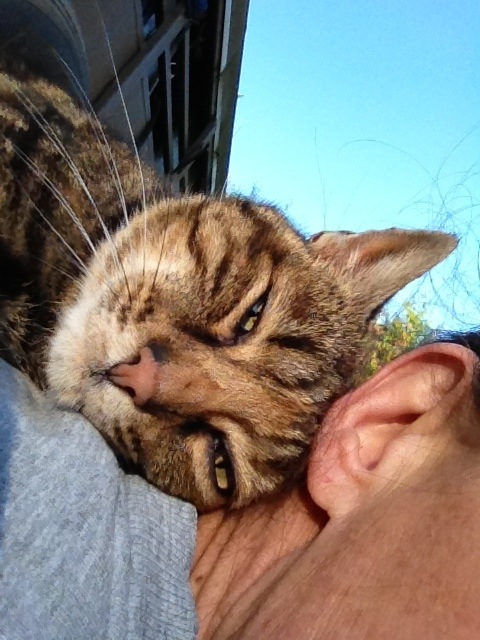
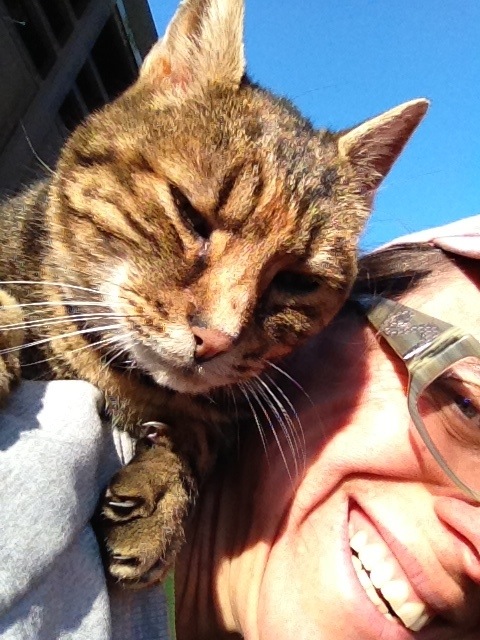
At least, don’t sit down anywhere that Iago (friendliest barn cat on the planet) can find you. She will mug you, jump on your back, smother you with kisses, turn on her rumble purr, and do everything in her considerable feline power to stop you from getting back to the job at hand…

Barn Cat Love Attack

“Heh, heh, heh – this human thinks she is going to unhitch the horse trailer… Wrong!”

Iago

“First, I will give her a massage with bonus acupuncture treatment…”

Barn cat at work...

“Then, I will clean out her ears… hold still, human!”

Barn Cat

“Oh it’s so easy to make these humans laugh… Now. Let’s see if she’ll follow me up to the barn and give me a snack.”

Clipping the Flight Feathers on a Chicken

A video and diagram showing you how to clip your chicken’s flight feathers. Very handy if your birds are prone to flying the coop…

Pickled Beets!

20131102-180403.jpg

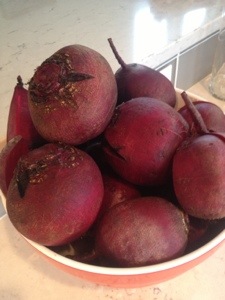
I love pickled beets. The only problem is, it takes HOURS to make them! Fortunately, I was not alone and was, in fact, talked into embarking on the project by my lovely future son-in-law, Toryn. So, with all the decks cleared, we started with tons of beets from Michell’s Farm Market down the road (all of ours went into our customer goody boxes – doesn’t that just figure!).

20131102-174525.jpg

First step was to sort the beets into piles that were more or less the same size. The smaller ones we cooked whole, larger ones were chopped up a bit first. We boiled them for about ten minutes after first topping and tailing.

20131102-180351.jpg

After boiling, we doused the beets in cold water. That makes the skins slip off quite easily.

20131102-180339.jpg

THIS is a great tool!

20131102-180321.jpg

Dunking the beets in cold water.

20131102-174538.jpg

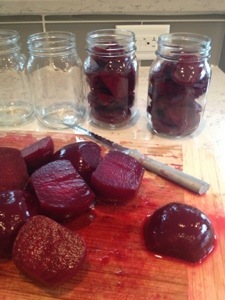
Due to popular demand, we sliced them all (instead of doing some in a chunkier style…).

20131102-180245.jpg

We added a malt vinegar and water mixture after we’d added a spoonful of pickling spices to each jar of sliced beets.

20131102-174554.jpg

At this point, the whole house smelled like vinegar and beets and all the windows were fogged up. Lids went on and the jars were gently lowered into a boiling water bath.

20131102-180306.jpg

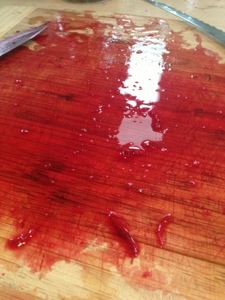
Beet juice and sharp knives everywhere! It was about halfway through several batches that I got a phonecall – “There’s a stray horse down at the barn!”

I sprinted down the hill and found a pony with some serious attitude pulling faces at my horses through the fence. She has visited our place before, so I knew where to take her. Leaving T. in charge of the beets, I hiked down the road with pony in tow. Fortunately, farming neighbour Mitchell happened to see me and gave me a ride back so I didn’t miss too much.

20131102-174513.jpg

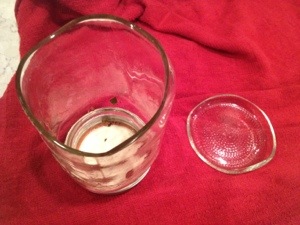
After T. left for work, I finished up the last batch. It was one of those situations where I could either have six very full jars or seven not very full jars and I opted for the former. Mistake! You know the part where they say ‘”leave plenty of head room?” There is a good reason for that… Fail to do so and your jar explodes due to all the super hot expanding liquid in the jar. Which is what happened in the last batch.

20131102-174447.jpg

The good news was that only one jar was lost. And, bonus, the bottom blew out very cleanly – no splinters or missing chunks of glass. So, the hogs were happy – they got some fancy beets as a treat!

20131102-174459.jpg

Not only did the bottom blow out, the whole jar flipped upside down in the water bath.

20131102-174434.jpg

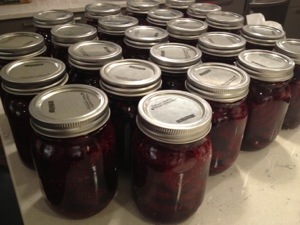
Fortunately, all the other jars sealed without trouble…

20131102-174421.jpg

We couldn’t wait the recommended three weeks before testing… so today after everything had cooled, we opened a jar.

20131102-174412.jpg

Grampy tries a beet… the ultimate taste test!

20131102-174401.jpg

Fortunately (because we have a lot of them!) the beets passed muster and made their way into a cheese and beet sandwich. As the rest of the beets sit in their jars they will absorb more of the vinegar and spice mix so the taste will be stronger, but even in their premature state, they are pretty yummy! Will throw some into the salad tonight!