Tag Archives: farm

Day 22 – Let’s Talk Turkey

They can run, but they can't hide...

They can run, but they can’t hide…

This year has been a bit of a challenge in terms of timing for processing our Christmas turkeys. Until very recently, the closest place to have the birds processed was up in Cowichan Bay an hour or so north of here – a journey that requires a VERY early start to get the birds there on time and then a return trip the following day to pick them up again (the processed birds can’t be transported until they have been sufficiently chilled). As you can imagine, the demand for slots is huge right before the two major turkey feasting holidays, so it is not easy at all to book a date that is close enough to Christmas to be able to offer customers fresh birds.

Add to this the fact our Ridley Bronze turkeys take their own sweet time growing to a decent size so an early date and frozen birds is not a great solution for us, never mind the fact our customers overwhelmingly prefer fresh birds to frozen (though, I have to say that having tasted both, there isn’t a noticeable difference in flavour). Anyway, the closest date we originally were able to get to Christmas was December 13, which meant very stale ‘fresh’ birds (too stale, really – though there is no definitive number of days a fresh bird can sit properly refrigerated, we were uncomfortable selling birds that would be 10-12 days before preparation). So, we were resigned to selling them frozen.

Invite a Ridley Bronze to your holiday dinner...

Invite a Ridley Bronze to your holiday dinner…

Then, we heard through the farmer grapevine that a new processor had been approved here on the Saanich Peninsula and, when I got in touch, I was delighted to hear he had space for our birds on December 21 (ready for us to pick up and get them to our customers December 22). Not only can we provide fresh birds, they benefit from an extra week or so of growing.

Now that we have the processing date finalized, I can post the link to our fancy schmantzy online order form.

Please note, we do not produce a huge number of birds and they grow to the sizes they want to grow. To avoid disappointment, please, please order sooner than later so you have the best chance of getting a bird close to the size you are hoping for. We do our best to match you up with a good dining partner, but it’s not like we are running a factory farm here with thousands of birds to pick from. We always sell out, so if you are interested in a fresh, local, delicious heritage turkey, click on that there link and let us know!

We are now able to take VISA and Mastercard – details for payment options are on the form. Over the next little while we’ll post some favourite recipes and cooking tips – these birds are not quite like the broad-breasted whites you’ll find in the supermarket. More on that, too, in future posts – for now, just wanted to give you the heads up on our late-breaking turkey news!
Day 13 – Chicken House Challenges Part 3

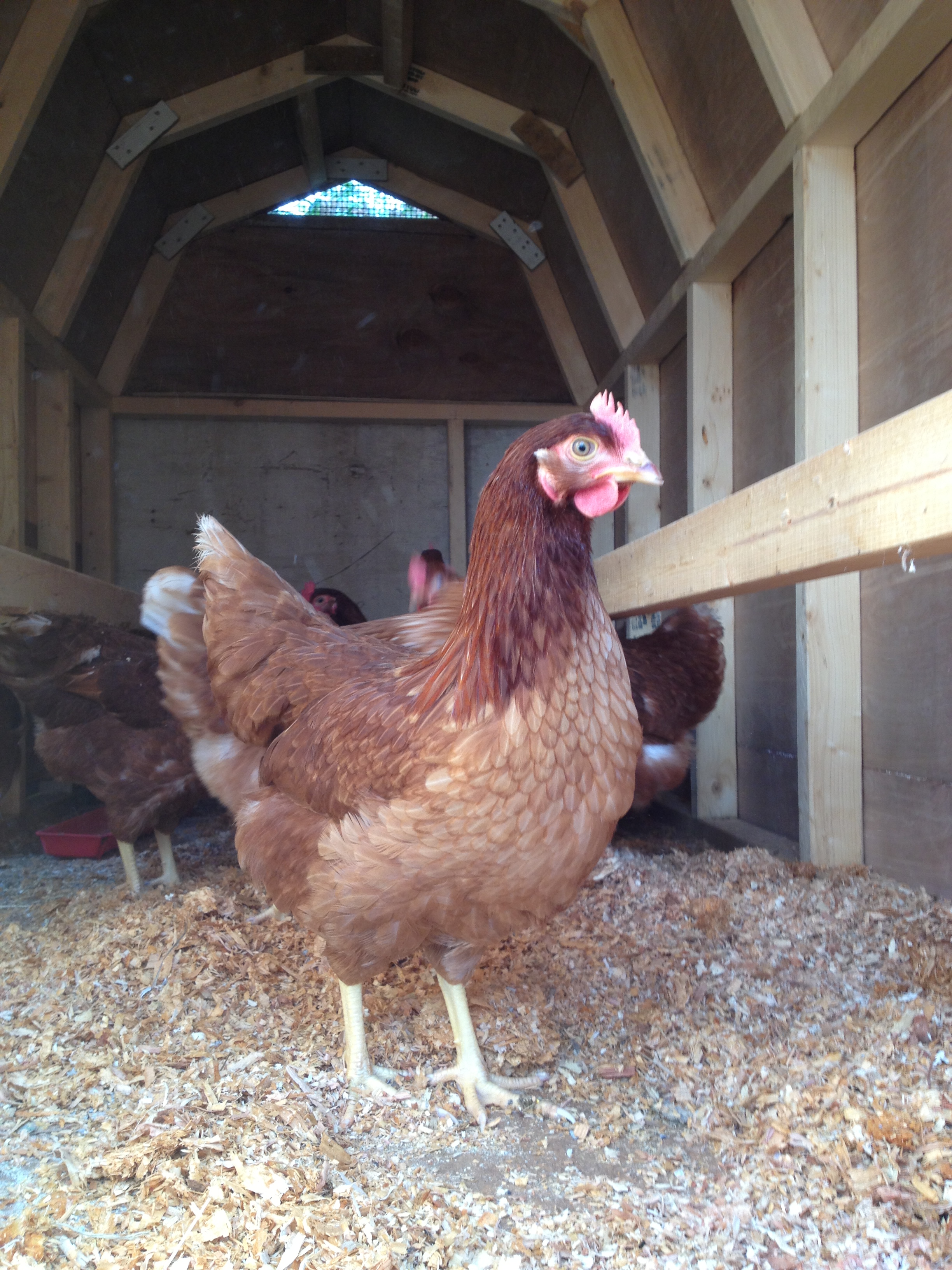
Meanwhile, inside the hen house, the girls were completely confused about where to sleep.

"You mean I'm supposed to jump up there?"

“You mean I’m supposed to jump up there?”

The first night, in fact, the girls couldn’t figure out how to walk back up the ramp, so they all piled up right at the bottom of the ramp, outside. By the second day they had figured that part out, but judging by the amount of hen manure in the nesting boxes and completely lack of bodies on the perches when I peeked in during the night, the girls hadn’t figured out that perches are for perching.

The next day, several of the hens had sorted out the perch situation, but nobody had laid an egg inside the nesting boxes, Instead, they are using the two back corners of the main area of the hen house. The next modification we’ll make is to add a low board across the bottom of the open side of the nest boxes. This will (I hope) accomplish two things: a) they won’t be able to shovel quite so much litter into the nest boxes when they are digging around in the shavings and b) they will feel more secluded, contained, and secure if they are behind more of a barrier.

Stay tuned…Interested in learning who else is participating in the 30 days agriculture blog-a-thon or the five things Holly Spangler will be talking about this month? Head over to Prairie Farmer to find out!

Here's a shot from the stage when we were gluing down the roofing felt on the nest box roof. The plywood is over the top of the roofing to evenly distribute the weight of the heavy objects placed on top.

Here’s a shot from the stage when we were gluing down the roofing felt on the nest box roof. The plywood is over the top of the roofing to evenly distribute the weight of the heavy objects placed on top.

Day 11 -Chicken House Challenges – Part Two

Well, that was frustrating yesterday! Just as I was getting on a roll, the blogging interface ceased to function properly and I couldn’t add images or text below the bottom picture! Not that a description of chicken house building is so compelling that stopping where I did counts as a cliff hanger, but if you are someone who likes to complete one thought before moving on to the next, sorry about that.

Sticky black goop to glue down the roof and seal everything... Roofing was also nailed down.

Sticky black goop to glue down the roof and seal everything… Roofing was also nailed down.

We were really, really careful to use lots of sticky black roofing goop (for some reason, as I did this, I kept thinking of Brer Rabbit and his tar and feathering incident) but even so, after everything was assembled and sealed (so we thought) we had a couple of leaks.

IMG_6764[1]In the next photo, you can see how we should have made the main/upper roof overhang a bit wider on the nesting box side of the building. Though we had also ‘roofed’ the nest boxes, the water dripped off the upper roof and enough collected in the seam between the exterior wall and the nest box top that a bit seeped inside. It wasn’t exactly a flood, but even a bit of water soaking into bedding would lead to mould and other nastiness down the road. At first we tried to caulk the crack with a silicone bead, but in the heavy rains, it just washed right out. We had to scrape out the ineffective goop and use a super-sealant that works to seal cracks even when wet. This did the trick and the interior is now staying bone dry.

Here's a view of the nesting box side with the ramp up.

Here’s a view of the nesting box side with the ramp up.

We thought we were being very clever to have the hens exit through a different door to the humans. This would mean they could carry on with their business while the human carried on with hers (human door is large and at the end of the building). The only problem was, by situating the hen ramp between the two nesting boxes, we created a bit of a design nightmare when it came to figuring out how to make a sort of chute for them to use when the ramp was down so they could get in and out of their protected run. Keep in mind we needed everything to be lightweight and movable.

Ramp down but no chute in place

Ramp down but no chute in place

Ramp down with chute - solid sides but no top on yet

Ramp down with chute – solid sides but no top on yet

After we had built a solid-sided chute, we realized we couldn’t fasten on a top of any kind because then one wouldn’t be able to lift the ramp up and down when the chute was in place. So the next step was to come up with a cap of some sort for this whole fancy system.

For this part, we built a very light frame and covered it with heavy mesh.

Mesh lid in place over the ramp

Mesh lid in place over the ramp

Perhaps predictably, the chickens were a bit confused when we first put them into the house. Eventually, though, they got it figured out and were running up and down the ramp with impunity.

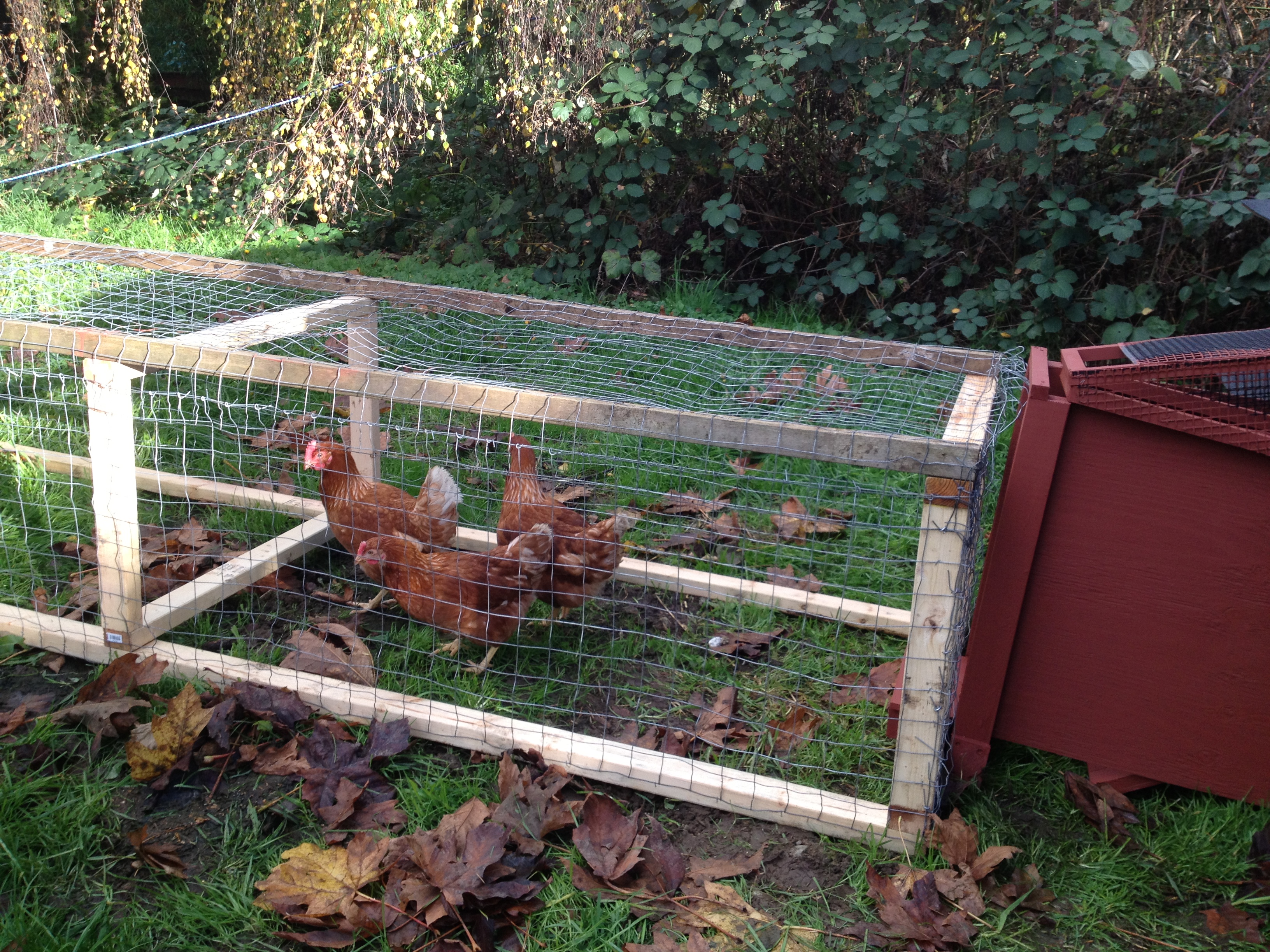
The ramp leads to a portable pen (only part of it seen in these photos – the long, narrow run was initially meant to lead to a larger, more square area, but we are going to repurpose the long, skinny run as a vegetable bed chicken cleanout run- as in, we’ll place it over a bed to be cleaned out in the garden, put a few chickens in there for a few hours and let them do some cultivating). The system of attaching the more square run will be similar to what you can see in the photos here.

In my next post I’ll talk about some issues we’ve had with the interior design and modifications we need to make to the nesting boxes… I’m thinking that by the time we have built our twenty-seventh chicken house we might just have all the bugs worked out!

IMG_6782[1]

Here are a couple of brave girls standing at the top of the ramp considering their options.

Long, narrow run that was meant to lead into a larger turnout area... plans have changed once again.

Long, narrow run that was meant to lead into a larger turnout area… plans have changed once again.

The girls quickly got pretty good at running in and out

The girls quickly got pretty good at running in and out

Chicken house and run set up for testing on the back lawn (so it was handy for modifications). The whole set-up will be moved to a larger poultry-raising field down the road.

Chicken house and run set up for testing on the back lawn (so it was handy for modifications). The whole set-up will be moved to a larger poultry-raising field down the road.

Interested in learning who else is participating in the 30 days agriculture blog-a-thon or the five things Holly Spangler will be talking about this month? Head over to Prairie Farmer to find out!

Day 6 – Living and Dying by Lists

It doesn't take long for critters around here to figure out the formula human + bucket = food

It doesn’t take long for critters around here to figure out the formula:
human + bucket = food

I don’t know where I would be without my lists. The TO-DO lists on the farm are endless – chores to do, things to fix, build, plant, harvest, clean, paint, scrape, haul, lug, prune, empty, fill…  I also have lists relating to current writing projects, and always have a list going of what things I need to pick up when I’m next in town.

Wednesdays are a painful list day as that’s the day each week I go to the feed store to stock up. Well, going to the feed store isn’t painful per se – I actually love checking in with everyone there, it’s quite the social event to see how everyone is doing — it’s the paying part that hurts. Right at the moment the turkeys are eating up a storm, the piglets (two litters on the verge of being weaned) have fully understood what their mothers get so excited about when I show up with the feed buckets, and this year’s pullets are full size and just starting to lay. Not that the girls are laying many eggs given the time of year, but still, everyone seems to be needing huge amounts of food these days!

Today, the feed store list looks like this:

5 bags organic hog mash
4 bags organic turkey mash
4 bags organic layer mash
4 bags timothy-alfalfa cubes
1 bag sheep feed
1 bag horse pellets
1 salt block (for the horses)
granulated salt (for the goats and sheep)
crushed oyster shell (for the layers)
shavings (for bedding in the various poultry houses)
garden stakes (not for the garden, but for the last bit of framing for the new chicken run)
Lunch Cart

At an average of 25.00 for a bag of organic feed, you can see why my hand shakes a bit each week when I pull the feed-needed list out of my pocket and start to give my order! I know these numbers would make a larger scale farmer laugh, but at the end of the year, if I lose a single litter of piglets to predation, a careless mother squishing them, or if a sow fails to get pregnant in the first place, poof – there goes whatever little profit I might have hoped to make with my modest hog operation! Meanwhile, the sows and the boar keep eating… and eating, and eating!

While I’m out I’ll also swing by a couple of local farm markets to pick up veggie scraps and two big sacks of feed carrots. Soon I’ll also be able to get feed apples, right about the time my friends have stopped dropping off boxes and bags of too-small, too-bruised windfalls they can’t use. Getting gas is also on the list (more pain – the truck is big!) as is picking up the newly repaired lawn tractor tire. There’s a list associated with that, too – all the little jobs I need to do once the tractor is back in operation.

Then, I’ll grab 15 bales of hay from the barn a couple of miles away from my place where I still have a couple of hundred bales stored for use through the winter. With the truck groaning and the dogs looking very uncomfortable perched together on the front seat of the truck (the feed bags completely fill the back seat of the cab but the dogs have been scolded so often for riding up front they look awfully guilty on feed days when they have to ride up front), I’ll make my way back to the farm to unload everything. (On the plus side, hauling all those hay bales and sacks of feed completely eliminates the need for a gym membership!) For a day or two I”ll feel wealthy, indeed – the cupboards full to bursting. Too soon, the empty feed bags will start to accumulate and I’ll start another list with:

Take empty feed bags to recycling depot.

How many of you are also list makers? What’s at the top of your To-Do list today?

National Hug a Chicken Day?

In honour of National Hug a Chicken Day...

In honour of National Hug a Chicken Day…

Well, why not? Have a peek at some of the many chicken-hugging photos over on the official Facebook page.