Tag Archives: e. colin williams

Dots, Lines and 3D (13/365)

FullSizeRender 2

Back to Basics: Red Dot, Green Line (pen and gouache)

Yesterday I left off with the thought that if lines and circles were a bit much to handle, perhaps I should have a better look at the good old dot.

Then Dad sent me this…
IMG_3222

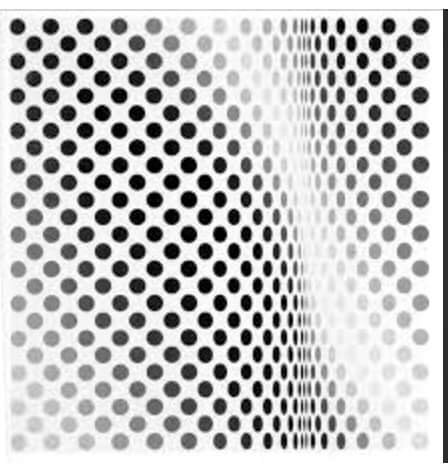
Pause, by Bridget Riley (1964)

Oh boy. I’d say mine is more… colourful? Clearly I have a lot to learn about dots. Bridget Riley was born in England in 1931 and became one of the big names in the Op Art movement. She was also the first woman to win (in 1968) the painting prize at the Venice Biennale. (More about her here.)

Dad was not done with lines, though… and also sent this:

IMG_3219

Thankfully, he also sent an explanatory comment about the Golden Section which was, apparently, the point of the series of boxes. I’ll try to explain in case you aren’t right up on your geometry. Top left – a square. Kind of boring. (I’m paraphrasing Dad here… there were a series of texts and then a lengthy phonecall before I got this all straight in my head). Next box – a square cut in half. Also kind of boring. Next up, a square cut in half in the other direction. Also not so interesting. Then, bisected squares bisected to make smaller squares. Ho-hum. And then, in the bottom row, things get interesting.

Basically, you take a square and bisect it (see bottom row, square on the left). Take the diagonal of one of the halves. Add that distance to the bottom line of the square on the left… the resulting rectangle (I’ve added some red lines to my version below) is roughly 1.65: 1 (length to height) ratio.


IMG_3223.JPG

Golden Ratio (more or less)


Mine isn’t super accurate as I didn’t use a compass or set square, so my measurements are not quite right, but you get the idea. Anyway, that basic rectangle in those proportions pops up over and over again in architecture dating back to those clever ancient Greeks. Even before that, the ratio appears in snail shells and the way in which the spiral pattern is formed in the seeds of a sunflower head. Those complex examples are waaaaaaaay beyond my capacity to draw, but the basic principle of the ratio remains the same.

Unrelated to the Golden Ratio, I was also determined to have a look at basic three dimensional shapes…

IMG_3218

The boxes are a bit wobbly and the one on the table top/flat surface to the right is all wrong as the two surfaces are on two different, incompatable planes… Which led us into a discussion about perspective that was accompanied by another flurry of diagrams from Dad. Which will have to wait until tomorrow as those messages spun off into a discussion of perspective, various other artists, primary colours, and art-themed movies not to be missed…



Lines (12/365)

The lines seemed to go a little better than the wobbly circles of yesterday… with the exception of trying to draw a square using a series of parallel diagonal lines. That was so not happening, especially when the lines angled down and to the right… clearly some neurological rewriting needs to happen before I get that right. My triangles are a bit asymmetrical and my straight, vertical lines all tend to have a bit of a leftward leaning tilt, but overall today’s exercise was not quite as painful as my efforts yesterday.

Mondrian Piet 1940 ish composition-no-10-1942

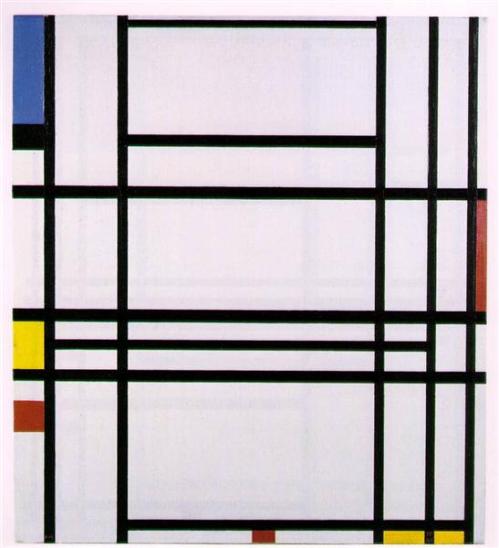
Composition No. 10, Piet Mondrian (1940-ish)

Piet Mondrian jumps to mind when I think of nice straight lines put to good use. What I didn’t expect was to see Van Gogh popping up in the Getty Museum’s handout intended for students learning about the elements of art. Line, of course, is one of those basic elements…


Van Gogh wheat-field-with-sheaves-and-arles-in-the-background-1888

Wheat Field with Sheaves and Arles in the Background, 1888 by Vincent van Gogh 


Check out all those lines!! There’s no real drawing going on here, per se… and yet… That’s a wheat field! And smoke from the factory chimneys! And stubble… and the impression of a real place made up of a bunch of short lines! Here’s a link to the handout, in case you want to have a go at filling in all the boxes with different types of lines.

I confess I was inspired and decided to give the line-making another go, this time based on the little boxes on the Getty handout…

More lines IMG_0189

It’s no wheat field, no Arles, but I can see how mastering some of these basic elements could prove useful someday.

Dad concurs. Right under the greeting ‘Happy Mother’s Day’ he texted, “Lines are really neat…” and then went on to illustrate with some quick examples. They were a little different to the Getty categories… Dad’s examples were:

  1. static straight lines
  2. straight lines showing slight movement
  3. more interesting/complex movement, still using only straight line
  4. quite a complex pattern, though not using many more lines (just varying length, angle, relative positions). Here’s my rendition of Dad’s example…

IMG_4504

No wonder I was having such trouble with circles! I was running before I could walk… I’m thinking maybe tomorrow I need to go back a step farther and maybe try a plain dot. I’d ask, ‘How hard could that be?’ but I am thinking even a dot could present mysterious challenges I can’t even imagine…

Take the Lowly Circle (11/365)

If you’ve been reading along for a while you will know I’ve long been hankering to up my game in the visual art department. Ok, more accurately, to have any sort of game at all. They say you need to start somewhere, so today I pulled out paper and pencil and tried to draw a circle.

My. God.

How hard could that possibly be? Hard!!

But if one masters the skill of the perfect freehand circle, one could go down in history. Like Giotto, the Italian painter who could, according to artistic legend, draw such a perfect circle it seemed he had used a compass.


This is a mural designed by Dad (shown here in progress) down in Ottawa, Illinois. One of Ottawa’s claims to fame is a glass factory where they made marbles (that’s a giant marble in the middle).


When I mentioned to Dad I was attempting to draw (in general, circles in particular) he immediately mentioned the ‘perfect O of Giotto.’ How could I not have known of this guy’s special talent before now?


APC Patrol Cyprus (1974) by E. Colin Williams (Note: circle turned ellipsis when viewed from an angle… I guess practicing my circles isn’t just a lame exercise…)


Giotto, turns out, didn’t just draw endless circles (though he must have drawn a few in his day to get so good). Though exactly who did what is hotly debated in art historian circles, this one is most likely Giotto’s work.


giotto st-paul.jpg

St. Paul (late 1200s) by Giotto di Bondone (Giotto)


One of my favourite factoids about the painter was discovered after an analysis of his front teeth upon his death. Apparently, they were worn away in a way that indicated he had spent a lot of time clenching a paintbrush between his front teeth!


Gerrit Dou 1630 35 the-extraction-of-tooth-1635.

Extraction of a Tooth by Gerrit Dou, 1630-ish


Note to self: if I ever dare to touch a paintbrush (after today’s painful experience with a pencil and a circle, I’m not sure I’ll ever get there), I will be sure to put it down when it’s not in use!! I need my teeth!!


Alberta Schoolhouse Doorknob by E. Colin Wiliams  (Here’s another painting by Dad, this one featuring several pretty good circles…)


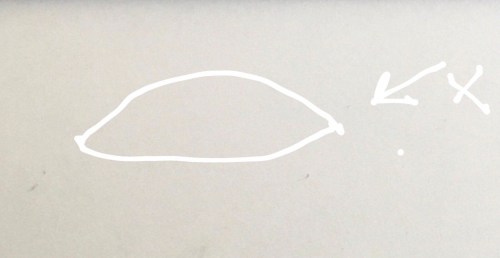
Dad’s hot circle tip: Practice!! And… ellipses are more difficult. People think they are pointy at the ends…


Dad sent this helpful illustration of what not to do in the ellipsis department…


Keep on drawing!! See you tomorrow…

S is for Slug, Snow, Spindrift, Spring and Street Art (#AtoZChallenge2018)


Spindrift IMG_2421

Spindrift [Fine snow that blows off a mountain… well, I guess it could blow off anywhere, but this was snow blowing around above the Bow Valley]

Snapseed 87

Snow is melting away before our eyes as spring finally, finally finds its way to the Bow Valley. This year, it seems like winter has been here for a very long time. 


S, it turns out, is full of potential when it comes to this month’s daily blogging challenge! It seems everywhere I look it’s all about transformation (the theme this month is Travel, Transformation and Transition…).

Over the past couple of weeks I’ve been receiving updates on a watercolour painting from Dad’s studio…


IMG_2423

In an artist’s studio, ideas are transformed into drawings, paintings, prints, lino cuts… 


The subject matter? Unusual, to say the least!


IMG_2428

Slug, slowly making his way to completion… 


IMG_2422 Slug ECW

Slug on the Camino by E. Colin Williams (2018)


IMG_2435

Stormy Seas… by E. Colin Williams (Oil on Board) I don’t think that’s actually the real title, but today is day so I’ll leave it for now… I’m sure Dad will let me the correct title. 


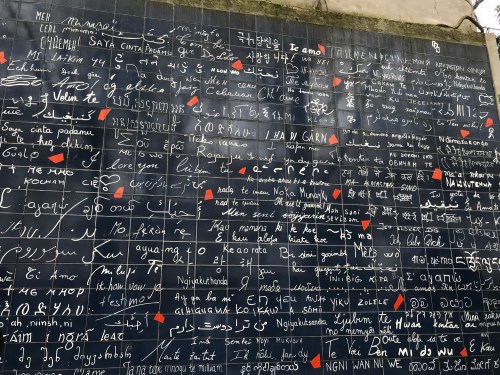
When I travel, one of the things I love to photograph is the street art I come across. Somehow, even the roughest of neighbourhoods, most rustic back alleys, decrepit sheds, and ramshackle fences are transformed when someone takes the time to add a little art… Here are a few pieces of street art spotted while wondering through Paris earlier this month…

IMG_1800 2.JPG

IMG_1801 2.JPG

IMG_1802 2.JPGIMG_1804 2.JPG

IMG_1808 2.JPG

IMG_1793 2.JPG

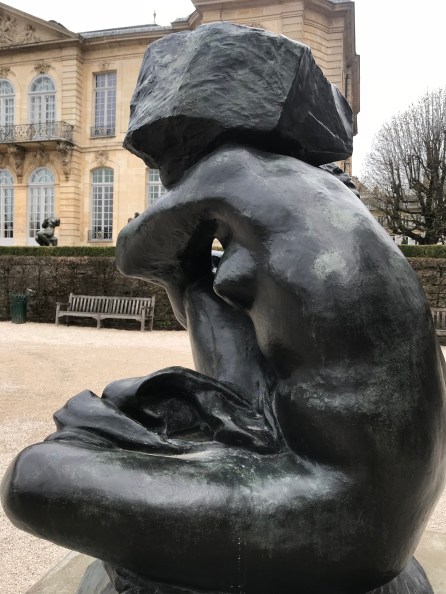
And, of course, I can’t leave this post without mentioning Rodin and this piece of sculpture featuring a great stone… Oh, I sure did enjoy myself in Rodin’s garden!

IMG_1702 2

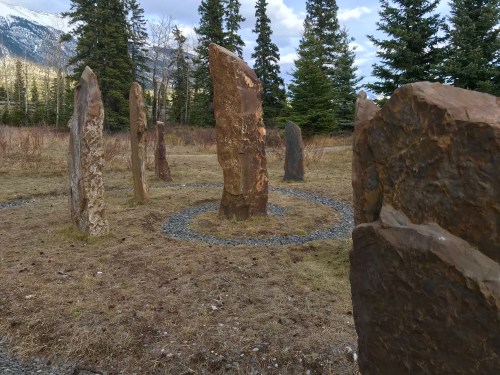
Oh, one last thought… sometimes the stones themselves become works of art as in this installation not far from my place here in Canmore.


IMG_2409.jpg

Portal XII by Lucie Bause, 2011


I could keep going for hours, but it’s been a very long day staring at the computer as I work my way through the draft of the new manuscript and my eyeballs are getting more square by the minute! So, away I go to slip off to SLEEP so I can transition into T is for tomorrow!


Abbott Handerson Thayer 1887 sleep-1887.jpg!Large

Sleep by Abbott Handersaon Thayer, 1887


World Art Day – and Week Two Recap (#AtoZChallenge2018)

According to my source (thanks, Dad!) today is World Art Day! Given that Dad was the first artist I met (and certainly the one I’ve known for the longest), here’s a black and white photo of an early painting from Australia.


The Rocks

The Rocks by E. Colin Williams – not sure of the date – 1967ish?


This is an old area of Sydney – here’s a link to the Wikipedia page about The Rocks, now a touristy destination while still preserving some of the flavour of this historic district.

All these many years later, Dad is still going strong, still painting, still exploring new subjects, materials and techniques. Yes, he’s my father so I’m a bit biased, but I find him inspiring and love getting texts each day with updates from the studio. I never know what to expect and it’s so cool to be able to see paintings as they progress from the roughest of sketches to finished works.


IMG_6202 ECW Self Portrait

Self Portrait, 2015 E. Colin Williams Unfortunately, this photo isn’t really sharp, but it’s kind of fun to see the artist posing with the artist…


Hmm… I’ve been enjoying the daily blogging challenge this month – maybe I’ll continue for another month and just blog daily about Dad’s projects. He’s got lots on the go at the moment – then you could all see the cool stuff I get to see arriving on my phone each day…

I will chew on that between now and the end of April … Let me know in the comments if you’d be interested in an ECW Art-themed month of blog posts starting in May.

Meanwhile, here are links to this past week’s blog posts:

Day 9 – H is for Home

Day 10 – I is for Ice

Day 11- J is for Jumping Jehosephat (and a BUNCH of other fun J words)

Day 12 – K is for Kisses, Klimt and Kerouac

Day 13 – L is for Landscape, Leonardo, Liu, Lowery, Lichtenstein and Lots more…

Day 14 – M is for Mary, Mountain (but not Montmartre)

See you tomorrow when we return to our regularly scheduled alphabet… Thanks for reading!