Tag Archives: chickens

Day 4 – Five Odd Questions About Poultry

I like Holly Spangler’s idea of posting short lists… so today’s post is a list of five questions we’ve been asked about our eggs and poultry.

1. Do you need a rooster for your hens to lay eggs?

We get asked this question all the time, so in case you have been wondering but were too shy to ask, the answer is no. Hens happily lay eggs even when there is no rooster around. If you want your eggs to hatch out chicks, that’s a different matter.

Chicken Eggs

Most grocery store eggs are either brown or white, but chicken eggs come in a range of colours. We find eggs that are pale blue, green, creamy-coloured, dark brown, pale brown, speckled, and plain. They also vary widely in size and shape depending on the particular breed of chicken, age of the hen, and season. Yolk colour also varies and ranges from yellow to deep orange to almost red. Yolk variations are most dramatic in response to changing fruits and vegetables we feed to supplement the birds’ standard diet of pasture and grain.

2. How long is a turkey pregnant?

Errr… turkeys don’t get pregnant, nor do they suckle their young. They lay eggs like other birds. It takes them about 28 days of incubation to hatch out a clutch. That’s shorter than our ducks and longer than the chickens.

3. Can you eat turkey eggs?

Absolutely. They are delicious! After we’ve collected enough eggs to incubate and hatch out for holiday birds we eat the rest of the eggs laid that season. Though, as our customers learn how good our turkey eggs are (and, how large – they are about double the size of a decent-sized chicken egg) we are finding we have fewer and fewer left for our fridge!

4. Can you cross a duck and a chicken?

Not any more successfully than you could cross a cat and a dog. Though, our rooster Wimpy is a bit in love with one of our Muscovy ducks and has certainly been trying to pull this off.

5. Does the rooster fertilize the eggs externally?

The asker did not clarify exactly how this was supposed to happen, but I can only imagine he was thinking about how our local salmon do this. Ever since, I have been keeping an eye open for our rooster stalking around the orchard looking for unattended nests so he could… err… squat and sprinkle.

The serious answer is ‘no.’ Chicken reproduction occurs internally. I won’t go into further detail as this is a family-friendly blog, but if you are curious, this website has a lot of excellent information about how all that works…

Interested in learning who else is participating in the 30 days blog-a-thon or the five things Holly Spangler will be talking about all month long? Head over to Prairie Farmer to find out!

Where the Chicken House Experiments Began

Chicken House #1

We’re going to replace the small wheels with larger ones to make the house easier to move.

We’ve been playing around with chicken house designs for a while now. The first version was low-slung with two wheels at one end and two handles at the other. It can be moved easily by one person as long as the terrain is reasonably un-bumpy.

The whole roof is hinged and inside there’s a single perch and four nesting boxes.

The whole roof lifts open for ease of egg-collecting and cleaning.

The whole roof lifts open for ease of egg-collecting and cleaning.

We found it was the perfect size for bantams, though we have also used it when we needed to segregate a few Light Brahma hens with Bill during breeding season. This solid house has a locking door for security at night. That door opened into a wire chute, which led to one of our hoop-house design wire runs. The whole thing (house plus attached portable run) is easily moved and, for a few bantams, provides lots of protection from birds of prey (we have trouble with eagles, ravens, and hawks). They get fresh grass and safe outdoor living while being protected. But, it was really too small for full-sized chickens on a long-term basis.

So, we built a bigger chicken house and a larger attached run-out, which will be the subject of a future post.

Pippi standing beside the chicken house for scale - not that this helps if you don't know how tall she is! If you haven't met her in person, she is just a bit taller than my knees. If you haven't met me, that's not particularly tall.

Pippi standing beside the chicken house for scale – not that this helps if you don’t know how tall she is! If you haven’t met her in person, she is just a bit taller than my knees. If you haven’t met me, that’s not particularly tall. So maybe putting the dog in there wasn’t very useful at all!

Almost Done the New Chicken House!

Because we don’t have a lot of land, I rent various nearby fields so my creatures can graze and forage. This means I rely on having portable pens and shelters to keep everyone safe at night no matter where they happen to be camping.

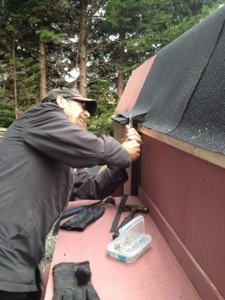
This new chicken coop is pretty fancy! Built on a chassis we bought on sale, it can be moved by one person on level ground or hauled around by my riding mower when the terrain is a bit trickier or the distance longer. Recently, we’ve had some problems with egg eating hens, so the nesting boxes in this coop have sloped floors that lead to a covered collection trough. Dad has been busy, busy, busy working on this creation which should be ready for new residents very soon!

20131026-172233.jpg

20131026-172244.jpg

20131026-172306.jpg

Wimpy Shepherds his Flock

One of these birds is not like the others... One of these birds doesn't belong...

Every time I see Wimpy the rooster wandering around with his flock of Muscovy girls that old song from Sesame Street pops into my head!

We procured Wimpy at the Metchosin Poultry Swap thinking we’d add him to our new flock of young laying hens. While we were getting the portable pens ready (the chickens will be moved from place to place, grazing and eating bugs – more on how we’re setting this up in another post), we needed somewhere to put Wimpy. We put him in with the Bantam flock thinking he was so much bigger than everybody else he would hold his own just fine. Turns out, in the world of chickens, size does not matter.

The Bantam roosters (we have nine of them – they all get along fine as they were raised together) are perhaps a quarter of the size of the hefty Wimpy, but they had no mercy for their larger roomie. They ganged up and harassed him relentlessly until the poor guy wouldn’t come out of the corner where the Bantams had driven him.

The sight was so pathetic (every time Wimpy even looked at the rest of the flock, the Bantams charged him until he resumed full cowering position in the corner) we rescued him and put him in with the Muscovy girls. The ducks are so sweet they accepted him into their group with no problems at all. Despite a few confused attempts at mounting the girls (Wimpy! that will never work!) Wimpy has settled in nicely with his new pals.

He is first into the duck house at night where he takes his spot on the roost above the girls’ nest boxes and roosting shelf. He starts crowing in there just before dawn and then patrols about most self-importantly after everyone gets let out in the morning. He is the first on the scene every time a human appears, first to call out at the sight of a raven overhead, and first to investigate when a couple of the Muscovy drakes start squabbling over the girls.

Banties Arrive

20120313-214659.jpg The bantams have arrived! As have the Ridley Bronze turkeys. I don’t have any good pictures of the Ridleys yet but will post as soon as I do. Meanwhile, my barnyard finally sounds like a real barnyard.