Category Archives: Uncategorized

And Now, Root Vegetables: The rutabaga vs the turnip

What is the difference, anyway?

What is the difference, anyway?

After yesterday’s topic of discussion (which has triggered quite the mind-bending conversation over in the comments) I feel the need to return to a subject that’s a tad easier to wrap my head around. What is the difference between a turnip and a rutabaga?
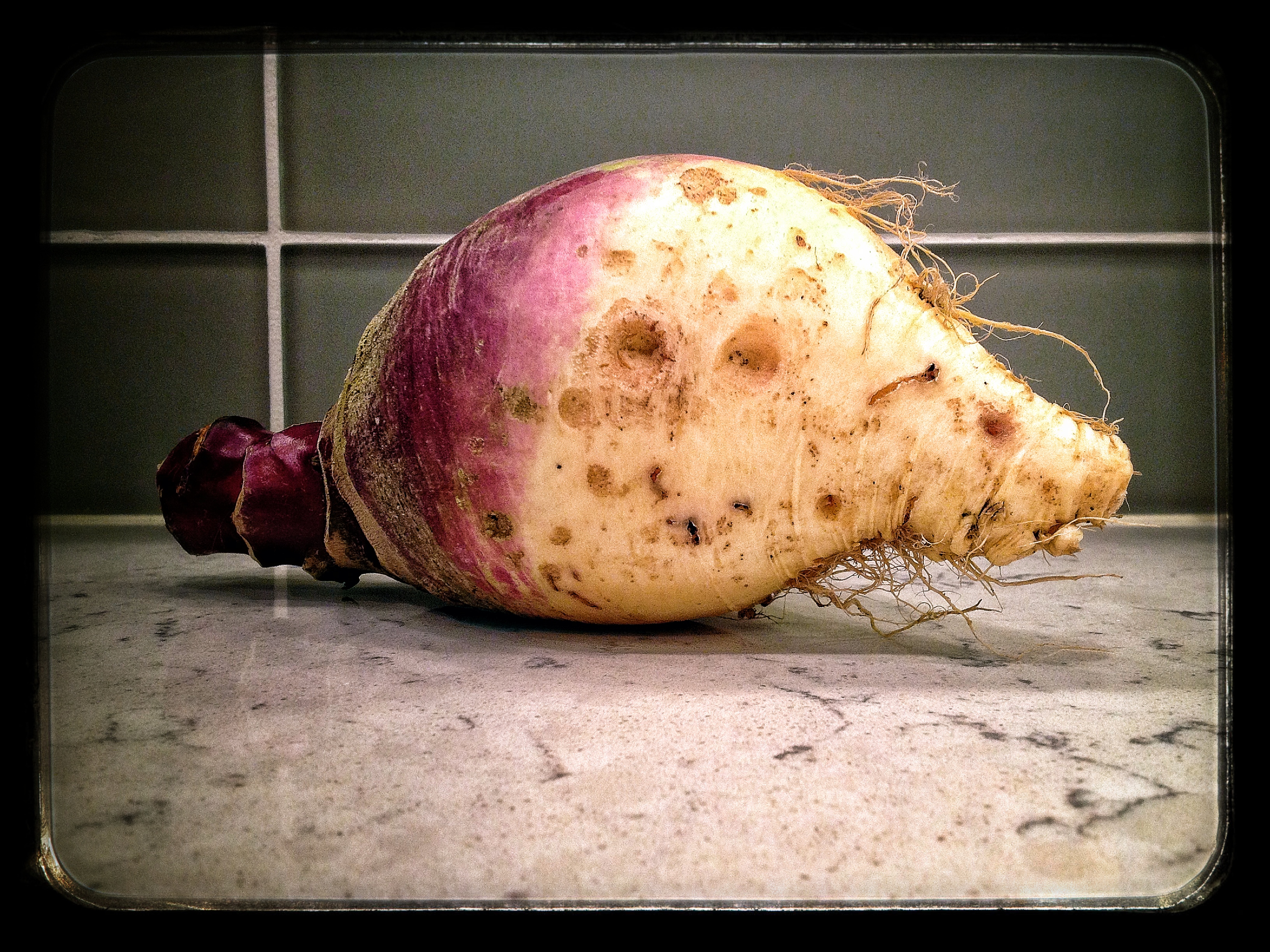
Rutabaga

Behold the Mighty Rutabaga

When I posed this question to Dad he muttered, “Swedes?” and then something about cattle feed. According to Wikipedia, it’s common in the north of England (Dad’s original stomping grounds) to call a rutabaga (aka the ‘swede’ – from ‘Swedish turnip’) a turnip. Dad’s reference to cattle feed is a standard comment delivered whenever I mention certain easily grown vegetables which, apparently, were  deemed unfit for human consumption by Brits during WWII. Kale, collards, turnips, and parsnips are the main culprits and if the Queen would never deign to eat cattle food, then why should he? 

Turnip

Turnip

Unfit for human consumption isn’t quite right – it seems to have been more that things were so bad during the war people were reduced to eating fodder more often consumed by cattle and hogs. Though Dad now eats collard greens, turnips, and rutabags, he draws the line at kale. Steamed, baked, or served up as chips- kale remains in the cattle feed bucket as far as he’s concerned, regardless of kale’s current status as a super food.

Back to the question at hand, what is the difference between turnips and rutabagas?

According to Niki Jabour’s very good book,
The Year-Round Vegetable Gardener: How to Grow Your Own Food 365 Days a Year, No Matter Where You Live I’m not the only one a bit confused about the exact differences. Both are in the cabbage family with bulbous roots and the varieties I’m familiar with sport the same colour scheme (white toward the root end and pink blooming into a deep purple toward the greens end). Turnips, though, are smaller and rounder (Niki harvests hers 6-8 weeks after seeding). Rutabagas are BIG (they can be up to six inches across) and take much longer to mature. In both cases,  you can eat the greens (we harvested all manner of brassica greens last year and sold them in our early goody boxes as braising greens – delicious!)

Niki suggests sowing turnips in cold frames late in the winter and then continuing to sow out in the garden from late April through mid-August. Rutabagas, on the other hand, she treats as a once a year crop, planted in early summer and harvested in the fall after 3-4 months of growth. Turnips can be eaten raw (I’ve never tried this, but Dad remembers snacking on them as a child… though if he called Swedes (actually rutabagas) turnips, then I’m not entirely sure what he called a turnip…) Rutabagas are generally cooked first.

Turnip v rutabaga - discrimination test - which is which?

Turnip v rutabaga – discrimination test – which is which?

We’ve used baby greens in salads but like most of the brassica family, they soon develop quite a strong taste and, when fully mature, can be bitter. Coat in butter or olive oil and add your savoury seasoning of choice and then sautee with garlic and perhaps a few onions and yum! A tasty veggie side dish.

I just stumbled across a recipe for mashed rutabagas and carrots, which I plan to try soon to take advantage of the gorgeous organic carrots Liz has been growing down at the end of the road. So good! We’ve been using them in salads, smoothies, and roasted  – mashed with rutabagas sounds like a cool addition to the list of carrot prep options.

Daily prompt: Mirror, Mirror – Felfies, Selfies, and the long tradition of the self portrait

Daily Prompt: Mirror, Mirror  Look in the mirror. Does the person you see match the person you feel like on the inside? How much stock do you put in appearances? Photographers, artists, poets: show us MIRRORED.

Some of my favourite paintings done by my father are his self portraits (accomplished by spending many long hours looking into a mirror suspended just off the side near his easel). They are him, certainly, but they are not – they are studies in portraiture, the human face, and, when looked at as a series, a story of a life being lived. In an early self-portrait he is clean shaven with a neat mustache, in a more recent painting he sports a full beard (something which still catches me by surprise as Dad only started wearing a beard in his 70s…)

E. Colin Williams, ARCAThis piece was the last done before Dad grew his beard. What is striking to me about these drawings and paintings is they completely lack any ‘say cheese’ quality ubiquitous in snapshots taken during family gatherings, vacations, or when friends get together for an evening of fun. I suppose that’s partly the result of having to sit and stare at yourself long enough to actually do some sort of hand-crafted rendering. Grinning like an idiot for hours and hours would surely cramp cheek muscles and quickly transform a big smile into a pained grimace.

The selfie (a self-portrait typically taken with a hand-held device and often intended to be uploaded to a social media site) can be a grinning snapshot (there are plenty out there of people snapping self-portraits with an off kilter Eiffel Tower in the background) or have a ‘look at me and this cool thing I’m doing with this awesome other person!’ flavour, but there are also lots of selfies out there that explore who we are in our everyday lives. Felfies (self-portraits of farmers) are an example of self-portraits of farmers from around the world in their natural environments doing their thing.

This is my selfie nod to Depression Era photographer, Dorothea Lange.

In this New York Times piece, James Franco suggests the selfie is a way to introduce ourselves to the wide world and for celebrities to feed their hungry fans with an endless diet of glimpses into their private lives.

The selfie as an art form is emerging as a fascinating way to capture how we see ourselves, how others see us, and, perhaps, how we want others to see us.

IMG_7725[1]

Selfie in Green

Staring Contest

Staring Contest with a Selfie

This article looks at the selfie as an art form and coincides with the opening of the National #Selfie Portrait Gallery. [Why, I wonder, are so many of the sample images included with the article taken in public washrooms?]

I have been working on a series of selfies that challenge cultural ideas of beauty and aging [don’t get me started… I could probably sustain a year of blogging relating to those issues]

In the end, will the selfie be an art form at which we roll our eyes?

Eye Roll Selfie

Or will it prove to be an uncanny way to uncover something about the self that lurks behind the cheesy smile of snapshots and only emerges when you spend some quiet time alone pointing your phone at your face…

[The Daily Prompt: Mirror, Mirror]

Aquaponics: a brief history

Wow – another very informative and timely blog post worth taking note of. We’ve been talking about experimenting with an aquaponics project here – I’m reblogging this in part so I can find it again! Tons of info and additional resources… Has anyone else had experience with projects like the ones described here?

Using Pallets To Build A Dream…

This blog post describes a pretty cool list of pallet projects!! I need a new mailbox down at the farm entrance…

oldworldgarden's avatarOld World Garden Farms

In a way, it’s comical that a simple, common, disposable item such as a pallet could be responsible for creating so much at our little farm. To most, pallets are nothing more than a few pieces of rough-sawn wood, assembled together to provide a stable base for safely shipping items around the world. For us, however, they were the inexpensive building blocks – and paved the way for us to realize the dream of creating our farm.

When we first started out – we made a promise to one another that no matter what – we would build the farm on a zero-debt premise.  We wanted to simplify our life, not complicate it – and it just didn’t make sense to do that by going in debt to build chicken coops, barns and more. We are both very proud that we have held completely true to that promise – and…

View original post 914 more words

Mark Your Calendars!

With apologies to distant readers, here’s a heads up re. some local farm-y events heading our way…

Egg Addling Workshop – (or interest to anyone dealing with the resident Canada Geese)
January 25, 2014, 9:30 – 4pm 
St Mary’s Anglican Church, 1973 Cultra Avenue, Saanichton
Free egg addling and permit training opportunity! Join us for information, addling training and support with completing permits related to resident, non-migratory geese. Workshop is free, but please RSVP 
 
Meet Your Maker Monday, January 27th, 2014
9:30am to 3:00pm
9:00-9:30am- Registration, Set-up & Coffee
Sannich Fairgrounds
1528 Stelly’s X-Road
Sannichton, BC
This event is a networking event for BC food producers and BC food buyers (not the general public.) Great opportunity for small producers to connect with local buyers (restaurants, wholesalers, grocery stores, etc.)
Registration is now open!
 

Islands Agricultural Show February 7-8, 2014

Celebrating the International Year of Family Farming
Cowichan Exhibition Park, Duncan, BC
Trade Show Hours: 8:30 am- 4:00 pm.
Trade show admission fee: $5.00 each for adults and children get in free
Conference registration includes admission to the trade show and Welcome Reception
 
SAVE ALR button
Family Day Rally to Save the Agricultural Land Reserve – February 10
http://farmlandprotection.ca/wp-content/uploads/2014/01/Feb10-Poster.pdf
Noon – BC Legislature Grounds
More info: Farmland Protection Coalition
 
 
Seeds, Glorious Seeds
February 15, 2014 Seedy Saturday – Victoria (**Note: Many communities organize a Seedy Saturday event at the beginning of the gardening season – have a google to see what’s happening in your area)
Saturday, February 15, 2014 
10am – 4pm 
Victoria Conference Centre, 720 Douglas Street
 $7 cash at the door
Under 16 free
  • Speaker Talks
  • Exhibitors (Enquiries at info@jamesbaymarket.com or voice message 250-381-5323)
  • Open-pollinated Seeds
  • Seedlings, Plants, Shrubs, Fruit Trees
  • Seed Exchange
  • Displays
  • Garden & Food Products
  • Books
  • Kids’ Activities
  • Master Gardeners
  • Chef Demonstrations
  • Seedy Cafe
  • ATM on Site
  • NEW: Gardening Book Exchange
  • NEW: School Scarecrow Contest
DFMA Banner
Vancouver Island direct Farm Market Association Spring Meeting –
February 20, 2014 
Oak Room, Main Hall, Saanich Fairground @ 7 pm. We are planning to invite several member farms who use social media tools to come and share their stories about how social media helps promote their farm or winery business.
 
Farmer 2 Farmer March 6, 2014
Thursday, March 6, 2014
9:00 am to 4:30 pm
Registration, coffee, meet ‘n’ greet 8:15 am
Saanich Fairgrounds
1528 Stelly’s Cross Road, Saanichton