Tag Archives: e. colin williams

L is for Landscape, Leonardo, Liu, Lowry, Lichtenstein and Lots more…


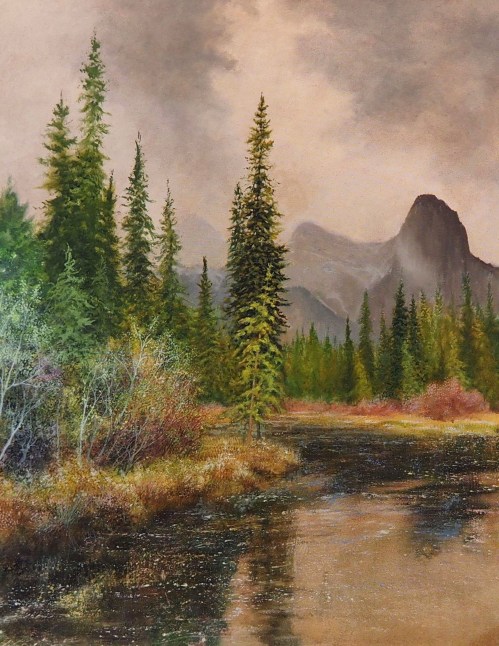
ECW Mountain and River.JPG

Mountain and River by E. Colin Williams. Yes, I’m lucky enough to live inside a landscape that looks a lot like this painting done by my father. 

Growing up I looked at a lot of landscapes – not just the ones we lived in and drove through but also the ones my father painted and my mother photographed. In a way, I got to see everything at least twice – once as a fleeting impression as I moved through the landscape and again, later after it had been filtered and transformed on its way to becoming a painting or a photograph.

Maybe because of that I love seeing how artists interpret the world we live in, how they try to capture the essence of a place on a two-dimensional surface.


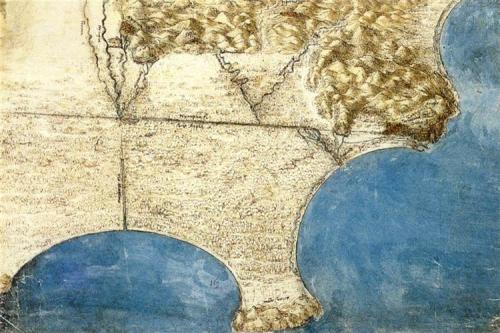
da vinci bird-s-eye-view-of-sea-coast

Leonardo (da Vinci) is not the first artist that jumps to my mind when I think of landscape painters. This painting is called Bird’s Eye View of Sea Coast and was painted in 1515. I find it fascinating because it feels quite abstract and clean in its execution, features the strangest composition, and shows the world from a perspective Leonardo could not have experienced firsthand. It’s a strange blend of cartography, art, and imagination. 


Lautrec painted lots of outdoorsy scenes, but generally they include people, horses, or both… This is very different to my father’s paintings which rarely included humans, birds or animals. Until recently, that is, when Dad has been exploring subjects he spent little time with earlier in his career (a topic I’ll explore in more depth in a later post).


Lautrec fishing-boat-1880

Fishing Boat by Henri de Toulouse-Lautrec, 1880


In the literary arts department, Jack London had a gift for capturing the landscape on the page. The Call of the Wild certainly evokes the brutality of the Yukon and the impact the landscape has on its inhabitants.


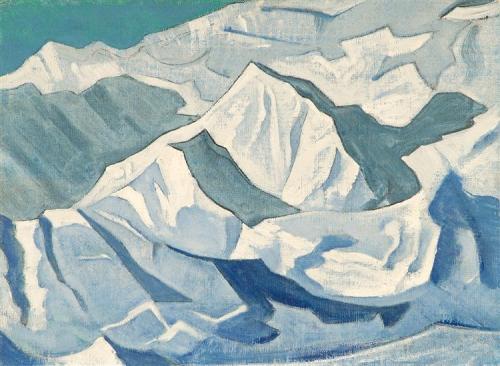
Roerich snowy-lift-1924.jpeg

Jack London was not the only one inspired by images of the frozen north. The Russian painter Nicholas Roerich often turned to the mountains in winter for inspiration. This is Snowy Lift (1924), by Nicholas Roerich


lichtenstein arctic-landscape-1964

Here’s Roy Lichtenstein’s take on the northern landscape. Arctic Landscape, 1964


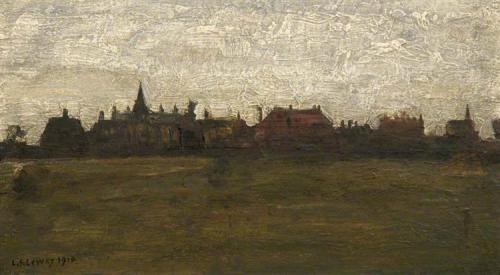
lowry clifton-junction-morning-1910.jpg!Large

L. S. Lowry’s dull as mud colours were typical of his early landscapes, this one from 1910. Though it’s titled Clifton Junction, Morning this hardly screams ‘morning light’ to me. 


van gogh enclosed-field-with-rising-sun-1889(1).jpg!Large

Compare Lowry’s somber morning with this exuberant sunburst by van Gogh. Enclosed Field with Rising Sun, 1889. 


And, finally, here’s a landscape by Georgia O’Keeffe… It may be abstract, but I can still see the landscape in the colours and natural forms.


okeeffe from-the-lake.jpg!Large

From the Lake, 1924 by Georgia O’Keeffe


Today I was priviledged to watch the amazing photographer Amy Liu at work. She was taking some photos of Ally Lacentra, super-talented young actor (and my step-daughter who, as luck would have it, has an abundance of Ls in her name).


IMG_2236

Amy and Ally at work – I felt bad for them as it was brisk outside today! Poor Ally had to try and look relaxed even when the chilly spring breeze blew down from the mountains! 


IMG_2237

One of the many gorgeous shots Amy Liu captured during the shoot today. Lovely!


And on that note, off I go to get back to work on the current work in progress. Let me know in the comments below if you have a favourite landscape painter…

Catch you later!


Portrait of a Pilgrim

The Plan

We are on our way back to North America after having spent about five weeks in Spain, most of that walking the last 120 kilometres or so of the Camino de Santiago. What was the point of all that, you might ask? Why did we feel the need to drag ourselves, and in the end, a wheelchair, across a chunk of northern Spain? It would be great if I could say something glib like, “Because it was there” or “Because we like to go on vacations with a bit of a twist” but it’s a bit more complicated than that.

Santiago de Compostela, Spain

For one thing, we can’t really afford to just jet off and wander around the Spanish countryside for weeks on end. Usually, we either need to find a way to keep working on the road (Internet access makes this possible, though it can also create huge logistical challenges when connectivity is not quite as good as we need it to be). Even better is when we can find a way to tie a project to a travel destination. Sometimes it’s as simple as writing a destination travel article about a place we want to go (or, happen to be going anyway). Sometimes it’s using a destination or activity that takes place in a distant place (climbing, for example) in a book. Taking copious notes, reference photos, or conducting interviews to gather information is a way to write some of the travel costs off as long as the material is used somewhere down the road.

Digital nomad at work in a small cafe in the middle of nowhere.

In the case of this trip along the Camino Frances, though, the intention all along was to write a book about the trip and to find a way to integrate art (Dad’a art in particular). Not only is Dad’s work integrated into the written project, he is also beavering away on a series of works exploring the idea of creating a portrait of a pilgrim to be presented in an exhibition of work.

At the end of a long day of walking, Dad works on a drawing of the Castillo de Pambre

One of the the good things about being a writer or an artist is that all of life becomes a potential source of inspiration. That’s also one of the tough aspects of this type of job. There isn’t really a way to shut life off, close the office door and go home. Everything is raw material and holds the potential of the next great bit of writing or amazing painting. For someone in the arts, each day could be the one where our desire to create something worthwhile is realized. Just the act of living life becomes a pilgrimage of sorts, full of challenges and roadblocks to overcome on the way to coming up with something decent.

When we set off on the road to Santiago we knew we wanted to create something (visual art on Dad’s part, written work from me and Dani), but beyond that we weren’t exactly sure what our story would be. After all, we had plans, but plans never exactly correspond with reality.

The good news is that post trip we have plenty of raw material for a book and Dad is well on his way to creating some very cool pieces unlike anything he has ever done before. The walking together, the conversations in the evenings, the time spent looking at art, watching Dad create art, listening to conversations among other pilgrims, reading about the act of pilgrimage, visiting museums – all that input, that raw material provided a massive amount of information, stimulation, and inspiration. The creative wheels aren’t just turning, they are spinning fast.

We knew that part of the challenge after a trip is coming back and being thrown into real life distractions, so we decided to spend a couple of weeks together after we finished walking to Santiago in order to focus on the project. The process has been as challenging as anything we faced on the journey.
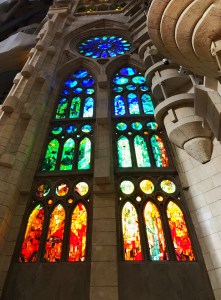
Sagrada Familia in Barcelona

Some of our conversations have been predictable – like comparing notes about various high (and low) points of the trip, but we’ve also talked about mortality, what inspires us, surprises like how much we all liked the Segrada Familia, Gaudi’s ode to nature and God in Barcelona, and what makes a great portrait. We’ve asked ourselves a lot of questions about the nature of pilgrimage and what a real pilgrim looks like. We sought out images of pilgrims in art and now, as we begin to write (and Dad continues to work with pen and ink and wax crayon and tempera paint sticks and watercolours) what is emerging is a story about our pilgrimage, but also a meditation on what it means to be a pilgrim – in words and images.

We collected dozens of pilgrim-related images on our trip… this one from the Pilgrim Museum in Santiago.

Dad is also exploring juxtapositions of self portraits with ancient depictions of pilgrims. He’s playing with stylistic twists and bold colour, taking fresh inspiration from time spent in the presence of Gaudi’s work, Picasso’s ever-evolving approaches to art and portraiture, and the many, many pilgrims we have seen in carvings, sculptures, murals, painted, drawn, and etched into stone.

We have been privy to Dad’s creative process in ways that have never been possible before now – living in close quarters for so long there is no way to avoid seeing how he comes up with ideas, starts sketching, restarts, scribbles, and polishes. At the same time, Dani and I have been clicking away on our keyboards.

The artist goes shopping – finding art supplies was easy in Barcelona.

I’ve been working on recreating our journey, integrating notes about art and history found along the way. I’m also trying to figure out the best way to share the conversations Dad and I have had over the past six weeks or so that we’ve been travelling together. Dani is digging deeper into the many moments that make up a pilgrim’s journey, writing a series of reflections and information essays that take the reader behind the scenes on subjects as varied as bedbugs and courier systems. The more we write and draw and talk and question, the more we discover to explore, describe, question and discuss.

Leaving Sarria…

“Is that where we are going?” Dad asks, pointing up.

“Unfortunately,” I answer.

“Oh my God. I haven’t trained for this.”

At one point we all worried that we wouldn’t have anything to say about our trip, that our three creative wells would simultaneously run dry. In fact, the opposite is happening. We all have found so much to explore I’m thinking our bigger task will not be thinking of what to include but what we will need to eventually trim out.
No fears about not having enough reference material!

Dutch Power!

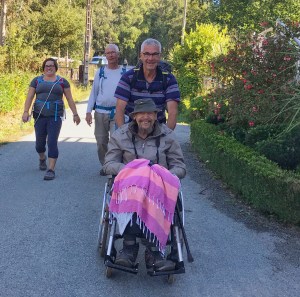
Dani and I were trucking along today and about the 6 kilometre mark after leaving our hostel in Salceda a couple of Dutch guys slowed down and insisted in taking a turn in pushing Dad. For a couple of kilometres they stuck with us, chatting away and helping us on all but the steepest of downhills.

Then, it was better for us to hook up our patented “D-brake” system, with Dani behind and connected to the wheelchair with the laundry line and me hanging on to the handles of the chair. As soon as we hit level ground again, though, the fellow from the Netherlands (I can’t believe that throughout the entire time we spent together nobody mentioned names!!!) took over again and kept pushing.

We made excellent time and found out about a documentary film called “I’ll Push You” https://youtu.be/W7gKD3q0-V0 about two friends, one in a wheelchair, who do the CAmino together. Turns out one of the Dutch brothers is a Camino-phile. This trip along the French Way is his fourth, his seventh Camino in total. In 2013 he happened to see the guys on their wheelchair trip, stopped and took a photo. Then, recently, he saw their documentary film and (I think) watched it with his brother. And, when the brothers saw us, they immediately wanted to stop and help.

It was pretty cool to hear their stories and share a bit of the journey with them. One of the things we have really missed in our journey so far was the camaraderie so many pilgrims speak of. Our Camino family has been limited to the three of us as moved so much slower than everyone else. Now, though, people don’t pass us nearly so quickly and when they do, it doesn’t throw them off schedule too much to walk with us for a short while and have a chat.

After a couple of kilometres it was time for us to stop for lunch, which was lovely in the warmth of a late autumn afternoon.

The Dutch brothersa continued on their way and then Dani, Dad and I finished up the day here in O Pedrouzo. As soon as I get somewhere where I can stream video, I’ll have to watch “I’ll Push You.” From the trailer, though, it makes our little jaunt look pretty cruisy!

The Kindness of Strangers

Albergue Camino Das Ocas

The common cold. A few days of feeling crummy, a runny nose, being irritated with the inconvenience of a cough. But really, it’s not that big a deal. Until you are past 80 and a cold is no longer a small thing to shrug off. A few days ago Dad started sniffling. Then the cough started. And now, several days in, this bug is hitting him hard. The past couple of days have been really tough going, so we had several conversations about what to do next. Send Dad ahead in a cab? Take an extra rest day and try to make time up later? Some combination of cab and walking where Dad went as far as he could and then we called a cab? That sounds reasonable, except a lot of the route is not on a road and given our limited Spanish, it could be tricky to describe which cow field near which hill we had chosen as a potential pickup point in the event Dad needed to be rescued en route.

Yesterday we visited a local hospital – nothing to do with the cold, but rather to get Dad a blood test. He takes blood thinners (post heart valve, he needs to keep things flowing smoothly) and he was due. While we were waiting to be seen, I noticed a couple of wheelchairs standing around in the waiting room and that made me think that perhaps we might be able to find one somewhere we could use to complete the journey.

We decided to see how last night was going to go and then make a decision this morning. At three in the morning I woke up to Dad’s coughing. Awful – persistent and grim-sounding. It didn’t sound like any walking was going to be on the cards. That’s when I really began to fret about where we were possibly going to find a wheelchair. It’s the weekend and Azura is not exactly a metropolis, though it is definitely bigger than many of the teeny one-farm villages we’ve stayed in. I wondered about the hospital and if, with my limited Spanish and Google translate I might be able to convince the to lend us a wheelchair. Then again, given how hard it had been to explain that we needed a common blood test, that seemed unlikely.

We had seen a couple of physiotherapy offices and I thought perhaps they might be able to help. Dani, too, tossed and turned all night and by morning, she was also formulating plans. Over breakfast we hatched a plot… Or first stop was to visit the helpful tourist info centre. The lovely woman on duty there did, indeed, offer suggestions – but because it was Saturday, they involved taking a bus to Santiago about 42 kms away. And, we were told, it was going to be tricky to find anyone open before Monday.

Back at the coffee shop where we had left Dad nursing a cafe con leche, we had a go at Google. We found a website called Accessible Spain Travel accessiblespaintravel.com with a phone number. I called and explained our situation and the very helpful guy at the other end said that he would see what he could find out for us.

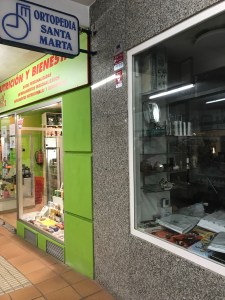
Not long after, he texted that everything was closed that might be useful in Arzúa but that he had managed to reach Jose Manuel in Santiago who could meet us at his shop as long as we could get there before 11 am. Though the shop was shut, he was willing to come and meet us and fix us up with a wheelchair. Alas, there was no way to get to Santiago by bus in time, so we sprinted back to the Info Center to find out where we might be able to get a taxi.

Once we figured out where the cabs were, we grabbed Dad and all leaped into the taxi with Pepin, our driver, who not only took us to Santiago, but then waited patiently in the street with Dad while Dani and I waited for Jose Manuel to arrive, let us in in and give us a wheelchair. That process was crazy – no forms to fill out, Jose didn’t even ask for my name – would only take 30 Euros for ten days rental, and wished us well.

Meanwhile, the taxi driver then drove us all the way back to Arzua but then took less than half of what should have been the metered fare.

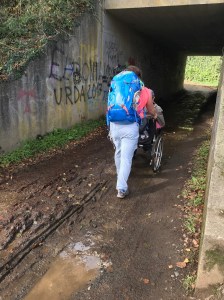
We were ravenous by the time we got back, so we had lunch and then set off. We experimented with all sorts of travelling variations – Dad pushing the wheelchair for a bit (which was ok on flat terrain and as long as the distances were short), Dani pushing, me pushing. Hills were an adventure. The going in places was steep and not exactly smooth. It took both of us pushing (Dani pushing the wheelchair and me pushing Dani) to get up some of the rough spots. Likewise, going down, it took two of us to slow things down – one of us leaning back against the handles and one pulling back on one of the walking poles we had attached to the back of the wheelchair.

By the time we finished our not-quite 5 kms, we were all bagged! A whole new set of muscles hurts! However, we made it!!! And it looks like we will get all the way to Santiago in one piece, as long as we keep going, don’t rush, and no further afflictions decide to sneak up on us.

One of the delights of the day was the contact we had with locals all along the way. A farmer (83) who walked with us for a bit after turning his cows out to pasture, a number of pilgrims who stopped to cheer us on (and take photos), the hostel-keeper who provided a great ground-floor, fully wheelchair accessible room for us, and a full-time pilgrim travelling with his donkey (worthy of a blog post all his own…)

Despite the physical challenges today (and, earlier, the stress of not knowing how on earth we were going to magically produce a wheelchair), today turned out to be a good day, in large part because of all the small kindnesses shown to us along the way.

Journey of a Thousand Miles Begins With a Single Step

The Chinese proverb sums up how we feel today after finally, finally setting off on our Camino adventure.

After several days of brilliant sun and hot temperatures, we were all relieved when it was cool and a bit foggy as we left the Albergue in Sarria. We were also pretty excited to spot our first yellow arrow and stylized shell indicating we were heading off in the correct direction. I have no idea how many arrows and other way markers we passed today – a lot – but each one is a small message of hope that we were a step closer to our destination.

h

The cooler temperatures helped mitigate the horror we all felt as we stood at the bottom of the daunting set of stairs that lead up and out of Sarria.

Dad has been training for months, but always on more or less level terrain and never with his daypack.

Thank goodness Dani planned today to be a shortish day. The total distance travelled was only about 4km, but it was tough going in places.

The old part of Sarria felt like the perfect place to start our journey, steeped in history and full of albergues and small

restaurants and bars it was also full of pilgrims.

We stopped often so Dad could catch his breath but by the time we started up the final hill leading to the village of Barbadelo Dad was pretty bagged. Dani and I redistributed everything he was carrying between the two of us and insisted on a refuelling break along the way.

At one point as Dad was puffing on his inhaler and looking pained, I thought we had perhaps made a terrible mistake. Much of today’s path was through the woods (yay – shade!!) but that did mean it would have been pretty well impossible to have hailed an ambulance should we have needed one. Various passing pilgrims stopped to ask if all was well or if we needed assistance. Dad waved them off, but I wondered several times if perhaps we needed to reassess and perhaps procure a donkey for Dad to ride for the rest of our journey.

Eventually, the grade lessened and our wooded path opened out into an area of fields and small farms and the going was much easier. By the time we reached Barbadelo, Dad was full of smiles and shocked both Dani and me when he declared the day to have been a lot of fun!

We are not going to set any speed records, that’s for sure, but if we just concentrate on one step at a time, eventually we will make it to our final destination.