Category Archives: Art

D is for Dying (#atozchallenge2018)


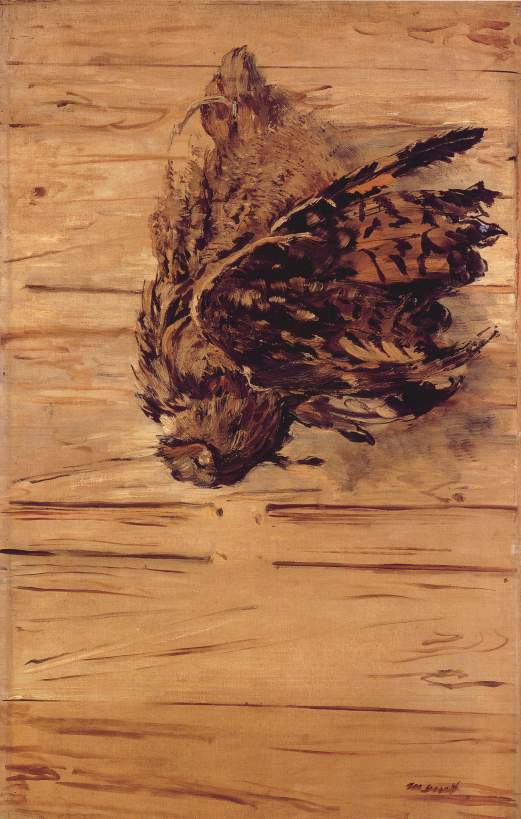
Édouard_Manet_-_Toter_Uhu Death Owl

Édouard Manet’s Dead Eagle Owl, 1881  Transforming death into art… 


The theme of this month’s blogging challenge is Transitions, Travel and Transformation. Dying could be said to be all three.

This past year I’ve read more about death (more precisely, the process of dying) than I would have thought possible. And, no – I have not developed a morbid obsession with the subject and no, I am not ill and no, nobody in the family has been stricken with a terminal illness. But I am writing a book for a new Orca Books series about the subject of medically assisted dying. What a rich and complex topic this has turned out to be!
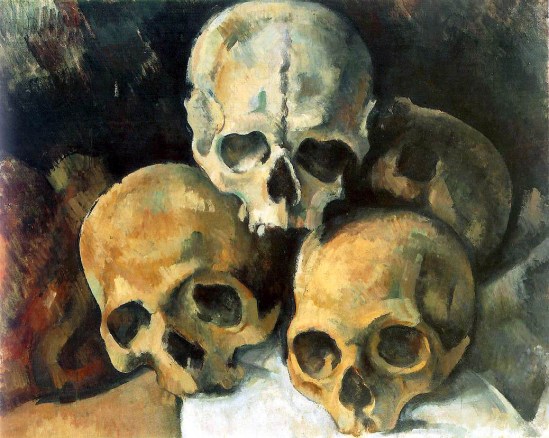
 

Paul_Cézanne,_Pyramid_of_Skulls,_c._1901

Pyramid of Skulls by Paul Cézanne, 1901


I remember my mother once telling me she had a terminal disease. I was, of course, horrified. She was quick to add, “well, so do you. So does everyone.” I was perhaps 11 and still didn’t quite get what point she was trying to make. Sensing my confusion she asked, “You do know what terminal means, don’t you?”

“You’re going to die?”

She nodded and laughed. “Aren’t you?”

The fact I still remember this exchange so many years later is indicative of how rattled I was at the time. I knew, in some theoretical way, that one day my parents would die. And, I suppose, I knew that we all have to go at some point, but it all seemed so removed from reality. So unlikely. I had not experienced death at that point. Had no idea what I was in for.


Paul_Cézanne_-_Young_Man_With_a_Skull

Paul Cezanne’s Young Man with a Skull


As a result of my reading and I research I asked my father (now in his early 80’s) if I could interview him for the book, you know, have a chat about death. He was a bit offended, I think, and replied that he wasn’t planning to go anywhere anytime soon.


Gustav_Klimt_-_Death_and_Life_-_Google_Art_Project

Gustav Klimt – Death and Life, 1915


This pair of conversations with my parents pretty much sums up our North American discomfort with the inevitable. Yes, we sort of know it’s coming – but later and to someone else first.
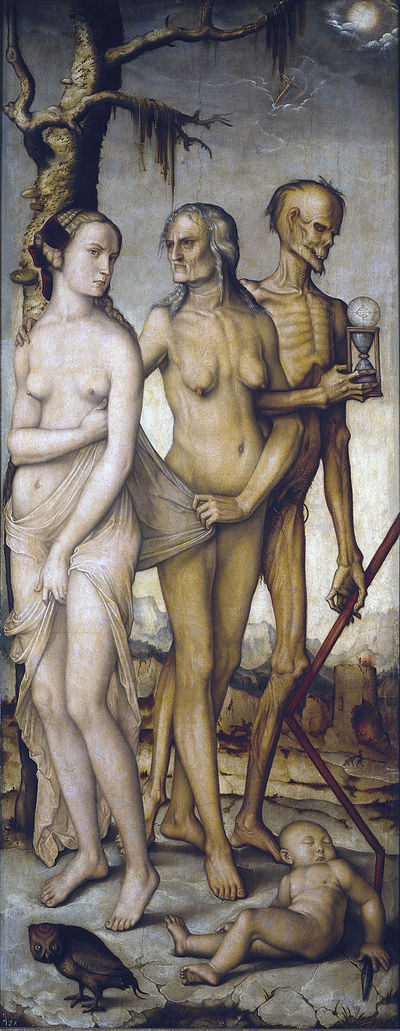
 

400px-Hans_Baldung_009.jpg

The Three Ages of Man and Death by Hans Baldung – 1541-ish


As a result, few of us have had proper discussions with loved ones about our wishes for end of life care. Even when we’ve carefully written out medical directives, the system (medical, legal) doesn’t always know quite what to do with them. It’s very hard to write a directive that will cover all circumstances. And, when the time comes, people sometimes change their minds and families are notorious for not wanting to let go.

I’m writing this post in the airport while waiting for my flight back to Canada from France. Assuming nothing goes dreadfully wrong, I’ll be back at home in about 20 hours from now. Given all the thinking and reading and ruminating I’ve been doing about the subject over the past many months, getting my thoughts and intentions regarding what I do and don’t want done with my dying body has now moved up on my To-Do list.


George_Frederick_Watts_Found_Drowned

Found Drowned by George Frederick Watts, 1850


What about you? Do you have an end-of-life directive? Do your loved ones know what it is? Have you had a conversation (or several) with those who may have to make those decisions on your behalf when the time comes? Let me know your thoughts in the comments below… See you tomorrow on the other side of the pond!

You know, you don’t need to wait until you are dead to consider how best to share your wealth around… If you find yourself in a contemplative (and generous) mood, consider becoming a patron to support the creation of these blog posts, photo essays, and short videos. In return, you’ll have my undying appreciation, but you’ll also get access to Patron-only content, advance peeks at works in progress, and more – all for as little as a buck a month! It’s easy – head on over to Patreon to have a look at how it all works. One of the things Patrons will find out about me in a private post is the location of my grave. I’m not in it yet, obviously, but we do have a family plot and I have staked my claim!


B is for Bordeaux, Beds (in art, in the flesh), Bourse (broken), Rue de Banque, my Blue Book, and a Bunch More (including a big brass band)! (#AtoZchallenge)


Snapseed 71

Warning: This post fueled by Bordeaux and sardines (the latter not shown, though they were consumed from a bowl)


There’s nothing like a quest (and/or the promise of a freebie) to get a girl up and out of bed on a Sunday morning. As I mentioned in my post yesterday, the Musée d’Orsay was free today (as are many of the museums in Paris, Sunday falling as it does this year on the 1st day of the month… no joke!), and I was determined not to miss out!


Snapseed 68

Musée d’Orsay – I promised myself I wouldn’t use this particular word even though it’s day today… but, I gotta’ say it – even before one starts roaming around, gawking at the abundance of stuff to be found here, the space itself is BEEEEE-autiful! Sorry. And, I promise – even though I saw a lot of beautiful things today, I won’t use the word again…


I didn’t wind up getting a super early start, which was a mistake. By the time I arrived at the museum the lineup was around the block and it took forever to get inside. The space is glorious – a former railway station – and, like all the great museums of the world, a tad overwhelming. Where to start?! My stomach answered that question for me (no, not the bathroom…) – lunch!


Snapseed 73

My table was back near the big, see-through clock… sort of at 5 o’clock.


I was so hungry I had no option – so off I went waaaaay up to the 5th floor where I sat at a table beside a massive clock, mostly transparent so I had a pretty good view of Sacre Coeur across the way while I ate. And what a feast it was!


Snapseed 67

This is what I didn’t eat… bread in a basket (yeah, being gluten free in Paris is a special kind of torture…) But the rest of the meal – ooh la la! Beans (green), breast (duck), baby greens, blue cheese… and walnuts (don’t start with B, but oh so good!).


Fortified and with a plan (while I enjoyed my meal I had a chance to study the museum app I’d downloaded in the loooooong line outside), I came up with a list of things to see that started with B. Arbitrary, yes, but when faced with a HUGE collection and very little time, one has to narrow the options down somehow. Here are some highlights.


Snapseed 65

Babes in a Bateau (or, Boat – works either way). By Claude Monet – more commonly known as La Barque à Giverny


Snapseed 64

Ballerinas by Edgar Degas (Le Foyer de la dande à l’Opéra de la rue Le Peletier)


IMG_9593

Oh I love this ballerina… Small Dancer: Aged 14  by Degas.


Snapseed 59

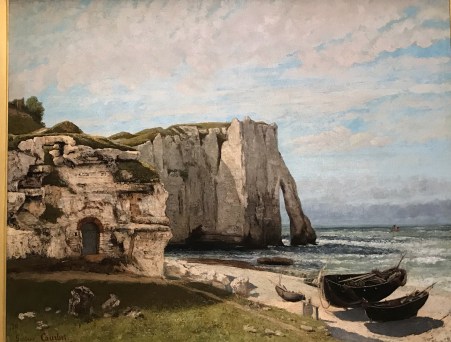
beach scene by Gustave Courbet (La Falaise d’Etretat Aprés l’Orage)


Snapseed 57

This pleasant scene in a bower… except you just know that because it’s by Gustave Courbet, that Bambi in the water has probably been startled by a horde of hunters…


Snapseed 58

Baying, bloodthirsty hounds bring down a buck… also by Courbet. Brutal.


Snapseed 63

Where the bourgeoisie go to play… the racetrack. Several paintings by Edgar Degas depicted scenes from the track.


Snapseed 56

This barnyard scene was typical of the Barbizon School… (this one by Constant Troyon)


Snapseed 60

There was LOTS of sculpture, including this bear by François Pompon.


Snapseed 62

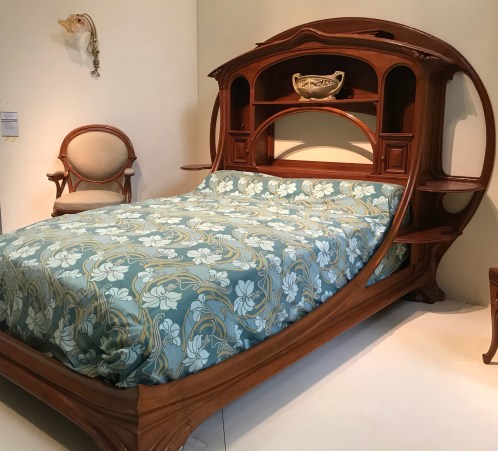
I was surprised how much I enjoyed the Art Nouveau furniture display… this bed was impressive… can’t imagine carrying it up six floors to my Paris walk-up, though.


IMG_9592

Speaking of beds, this is a great painting by Frédéric Bazille. This poor guy with the broken leg (in traction) is none other than Claude Monét. I’m not sure what the bucket and bowl are for… bedpan options? For catching drips in a leaky ceiling? Official title is L’Ambulance improvisée (1865).


Snapseed 61

Then there was this blue vase. This is an unedited photo, btw – that thing positively glowed!


Of course, there was lots more… but I’ll try to be somewhat respectful of bandwidth and stop there, though that wasn’t the end of my day.

After the museum finally spit me out, it was back to the Metro to find the station known as Bourse on Line 3. That was a bit of a joke as that whole section of line is out of commission for the weekend. So, I walked from the d’Orsay to Rue de la Banque in search of one of the famous covered passages of Paris. I had bought a book on my first day here, a slim guide to said passages, and this one sounded cool (and was on a road beginning with B).


Snapseed 53

Galerie Vivienne is gorgeous… I probably should have saved this for the letter V because I’m pretty sure nothing I’ll see on V-day will be as interesting. An L-shaped passe built between 1824 and 1826, it’s now home to small shops and cafés.


Snapseed 50

One of the fabulous finds in Galerie Vivienne was this bookshop. Sadly, it was closed today – all the more reason to come back!


Snapseed 26

Bonus! Bicycles!


I hadn’t actually intended to buy The Covered Passages of Paris. My intention was to pick up a copy of this little blue book


IMG_2040

Small enough to fit in a pocket, this guidebook is invaluable, well worth the five Euros I spent – and, blue!


I had a maroon-colored version that went missing on the last day of our trip here last year and I’ve missed it ever since. Sorry, Google maps are just not the same. Especially when your phone dies… Or when you are spatially dyslexic, as I am, and find it difficult to twirl the world around to match whatever orientation Google maps is spinning at you.

Back at the square beside the shuttered Bourse metro station, I stumbled upon a market selling all manner of random things including:


Snapseed 69

… a bistro set and a birdcage… 


Snapseed 30

…and this adorable baby buggy… 


At this point I could have gone home happy with my bulging bag of B booty (and, by this point, my feet were killing me), but as I approached Opera and the Metro station there, what did I hear but a Brass Band!! I kid you not…


After that, what was there to do but head home on Line 8, direction Balard…

Snapseed 52

And that, folks, is all she wrote for B-day. 

For museum hounds, what’s your all-time fave museum? I know, it’s like picking a favourite child, but let me know what’s on your must-see list! you tomorrow!

I didn’t film it, but I was one of many people who walked over and dropped a few coins in the open trombone case on the pavement… I mean, musicians have to eat, too… I’m sure you would have done the same thing! While you are in a ‘support the arts’ kind of mood, consider becoming a patron to support the creation of these blog posts, photo essays, and short videos. In return, you’ll have my undying appreciation, but you’ll also get access to Patron-only content, advance peeks at works in progress, and more – all for as little as a buck a month! It’s easy – head on over to Patreon to have a look at how it all works.

A is for Abbesses, Amelie, Artists and More (#AtoZ2018)

Well, I thought A might be for Art but that was three days ago before I had spent some time on the Paris Metro. When we were here last year I thought it would be great to do a journey to all the stations which are, conveniently, listed in alphabetical order here. The first station on the list is Abbesses, a name which always seems to me to have too many double letters…


Amelie at Abbesses Station AtoZ

This is the platform in Abbesses Metro station as depicted in Amelie. (That’s Amelie over on the left)


The deepest of all the stations (118 feet below street level), there are a lot of stairs to climb to get out of there. Reading a bit about it, I discovered it was used in the movie Amelie. Well, sort of… the set was made to look like Abbesses, but in fact, the filming was done at an abandoned platform at the Porte de Lilas station.


Abbesses IMG_1785

Abbesses during my visit today… the actual, real Abbesses. 


This tidbit led me to try to remember the movie Amelie, which I thought I had seen. Thanks to the miracles of modern technology, I found it on iTunes and watched it in my BNB (closest Metro station to where I’m staying is Lourmel on Line 8, named after General Lourmel who was killed in the Crimean War).


Abbesses Cinema Crop IMG_1790 2

Between the tourists, the garbage can, the shipping container and construction zone, it’s pretty hard to get a decent shot of the exterior entrance to the Abbesses Metro station. So, here’s a cinema-style letter box crop in an effort to make the best of a difficult photographic situation…


Turns out either I haven’t seen the movie or my memory is way worse than I could have imagined. I think the former as there are so many odd moments and bizarre scenes that something would have rung a bell, even if dimly…

As a result of watching (and thoroughly enjoying) the movie (and because I love my Navigo pass and any excuse to ride the Metro, particularly if it means a trip to Montmartre – location of Abbesses station), off I went to have a quick peek before heading to the Rodin Museum for my daily… oh, there it is… Art fix!


Rodin Argh BW IMG_1728

Do I share my ‘argh’ moment, or not? Ok, why not… I foolishly purchased my Rodin ticket twice! Once online in the wee hours of the morning and then again when I arrived at the museum. What can I say, I thought I was going to go to the Musée d’Orsay… which I am going to do tomorrow… And, since it’s the first Sunday in April, the d’Orsay will be free, so I won’t actually be out of pocket. Not really. But seriously, argh. 

What a bonus to find not one but several pieces of sculpture by Rodin that featured artists!


Rodin A is for Artist IMG_1722

For the sake of today’s A-themed post I will pretend I am not in Paris where this is obviously a peintre. Sadly, I will be long gone before the letter arrives!


Rodin hands IMG_1758

This is not a great photo for various reasons (it’s not sharp, for one thing), but I include it here because of the scale. The hands really were massive… 


Artists at Work Rodin IMG_1747

Art students hard at work sketching Rodin busts… How they managed to concentrate with all the tourists peeking over their shoulders and obnoxiously taking photos, I don’t know… 


While I was in Montmartre, I took my time wandering back downhill to jump on the Metro at Blanche. On my way I stopped in to poke around in the Montmartre Cemetery. There I found the grave of Endre Rozsda, a Hungarian-French artist who died at the age of 85 in 1999. I found this self-portrait online:


Endre_Rozsda_-_Autoportrait_(1939)

Endre Rozsda – born in Hungary in 1919 – this self-portrait dates from 1939


What’s your favourite movie set in Paris? The Red Balloon? Midnight in Paris? Let me know in the comments below… If I have time before I head home I might just go on another jaunt to a cool location captured on the silver screen. And, since we are also talking about A for Artists, who is your favourite artist who spent some time in Paris?

(Here’s a p.s. of sorts… the reason I may have been a little groggy at 2 am when I finally went to bed and bought that extra museum ticket is that I might have been slightly distracted by all the ads I was reading for Paris apartments. Ahh, dreaming. It’s always fun to fantasize about things like going shopping for a Paris apartment, though doing so right before bed resulted in some peculiar nightmares about buying an apartment and not having any money left for furniture.)

Nurture Your Inner Medici! 

Enjoy the blog? Consider becoming a patron to support the creation of these blog posts, photo essays, and short videos. In return, you’ll have my undying appreciation, but you’ll also get access to Patron-only content, advance peeks at works in progress, and more – all for as little as a buck a month! It’s easy – head on over to Patreon to have a look at how it all works. And, if enough (like a gazillion) of you all sign on, maybe that Paris apartment will be mine some day… and then you can come and visit and we can take photos of art together!! And then sit in a quaint café and talk about how we met right here at the end of a blog post about artists and Amelie and Abbesses and stuff…


Portrait of a Pilgrim

The Plan

We are on our way back to North America after having spent about five weeks in Spain, most of that walking the last 120 kilometres or so of the Camino de Santiago. What was the point of all that, you might ask? Why did we feel the need to drag ourselves, and in the end, a wheelchair, across a chunk of northern Spain? It would be great if I could say something glib like, “Because it was there” or “Because we like to go on vacations with a bit of a twist” but it’s a bit more complicated than that.

Santiago de Compostela, Spain

For one thing, we can’t really afford to just jet off and wander around the Spanish countryside for weeks on end. Usually, we either need to find a way to keep working on the road (Internet access makes this possible, though it can also create huge logistical challenges when connectivity is not quite as good as we need it to be). Even better is when we can find a way to tie a project to a travel destination. Sometimes it’s as simple as writing a destination travel article about a place we want to go (or, happen to be going anyway). Sometimes it’s using a destination or activity that takes place in a distant place (climbing, for example) in a book. Taking copious notes, reference photos, or conducting interviews to gather information is a way to write some of the travel costs off as long as the material is used somewhere down the road.

Digital nomad at work in a small cafe in the middle of nowhere.

In the case of this trip along the Camino Frances, though, the intention all along was to write a book about the trip and to find a way to integrate art (Dad’a art in particular). Not only is Dad’s work integrated into the written project, he is also beavering away on a series of works exploring the idea of creating a portrait of a pilgrim to be presented in an exhibition of work.

At the end of a long day of walking, Dad works on a drawing of the Castillo de Pambre
One of the the good things about being a writer or an artist is that all of life becomes a potential source of inspiration. That’s also one of the tough aspects of this type of job. There isn’t really a way to shut life off, close the office door and go home. Everything is raw material and holds the potential of the next great bit of writing or amazing painting. For someone in the arts, each day could be the one where our desire to create something worthwhile is realized. Just the act of living life becomes a pilgrimage of sorts, full of challenges and roadblocks to overcome on the way to coming up with something decent.

When we set off on the road to Santiago we knew we wanted to create something (visual art on Dad’s part, written work from me and Dani), but beyond that we weren’t exactly sure what our story would be. After all, we had plans, but plans never exactly correspond with reality.

The good news is that post trip we have plenty of raw material for a book and Dad is well on his way to creating some very cool pieces unlike anything he has ever done before. The walking together, the conversations in the evenings, the time spent looking at art, watching Dad create art, listening to conversations among other pilgrims, reading about the act of pilgrimage, visiting museums – all that input, that raw material provided a massive amount of information, stimulation, and inspiration. The creative wheels aren’t just turning, they are spinning fast.

We knew that part of the challenge after a trip is coming back and being thrown into real life distractions, so we decided to spend a couple of weeks together after we finished walking to Santiago in order to focus on the project. The process has been as challenging as anything we faced on the journey.

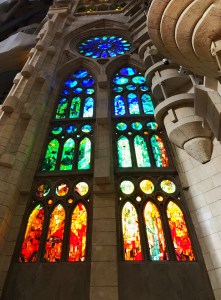
Sagrada Familia in Barcelona

Some of our conversations have been predictable – like comparing notes about various high (and low) points of the trip, but we’ve also talked about mortality, what inspires us, surprises like how much we all liked the Segrada Familia, Gaudi’s ode to nature and God in Barcelona, and what makes a great portrait. We’ve asked ourselves a lot of questions about the nature of pilgrimage and what a real pilgrim looks like. We sought out images of pilgrims in art and now, as we begin to write (and Dad continues to work with pen and ink and wax crayon and tempera paint sticks and watercolours) what is emerging is a story about our pilgrimage, but also a meditation on what it means to be a pilgrim – in words and images.

We collected dozens of pilgrim-related images on our trip… this one from the Pilgrim Museum in Santiago.

Dad is also exploring juxtapositions of self portraits with ancient depictions of pilgrims. He’s playing with stylistic twists and bold colour, taking fresh inspiration from time spent in the presence of Gaudi’s work, Picasso’s ever-evolving approaches to art and portraiture, and the many, many pilgrims we have seen in carvings, sculptures, murals, painted, drawn, and etched into stone.

We have been privy to Dad’s creative process in ways that have never been possible before now – living in close quarters for so long there is no way to avoid seeing how he comes up with ideas, starts sketching, restarts, scribbles, and polishes. At the same time, Dani and I have been clicking away on our keyboards.

The artist goes shopping – finding art supplies was easy in Barcelona.
I’ve been working on recreating our journey, integrating notes about art and history found along the way. I’m also trying to figure out the best way to share the conversations Dad and I have had over the past six weeks or so that we’ve been travelling together. Dani is digging deeper into the many moments that make up a pilgrim’s journey, writing a series of reflections and information essays that take the reader behind the scenes on subjects as varied as bedbugs and courier systems. The more we write and draw and talk and question, the more we discover to explore, describe, question and discuss.

Leaving Sarria…

“Is that where we are going?” Dad asks, pointing up.

“Unfortunately,” I answer.

“Oh my God. I haven’t trained for this.”

At one point we all worried that we wouldn’t have anything to say about our trip, that our three creative wells would simultaneously run dry. In fact, the opposite is happening. We all have found so much to explore I’m thinking our bigger task will not be thinking of what to include but what we will need to eventually trim out.

No fears about not having enough reference material!

Dad Draws a Tree

For as long as I can remember, I have loved to watch my father draw. It has always seemed to be somewhat miraculous the way images somehow seep out of the tip of his pencil (or flow from the brushes) and onto the page (or canvas). Because Dad will be recording his impressions of the Camino trip visually, we have been talking a lot recently about the artistic process and how he will capture his experience of the trip through his art.

We’ve decided to make a series of videos about Dad and his work – where he gets his ideas, how he ‘trains’ for a new project (more about that in a future post), and then how he gets what’s in his head onto the page. This first, short video (about two minutes long) shows him drawing a tree. Simple. But we wanted to set up the camera and do a test before we launch into anything more complicated. I have watched it several times now and still find it just as fascinating to see a tree appear from nothing as I did when I watched, captivated as he drew or painted something marvelous when I was a little girl.

patreon-logo

Enjoy the blog? Consider becoming a patron to support the creation of these blog posts, photo essays, and short videos. In return, you’ll have my undying appreciation, but you’ll also get access to Patron-only content, advance peeks at works in progress, and more – all for as little as a buck a month! It’s easy – head on over to Patreon to have a look at how it all works.