I’m thinking of going to this:
 Anybody else going? Drop me a line and let me know if you want to meet up…

I’m thinking of going to this:
Anybody else going? Drop me a line and let me know if you want to meet up…
I’d sure like to have a word with the chumps who carefully packed seeds or canes or whatever they brought with them from the Old Country and then carefully cultivated new Himalayan Blackberry patches in land formerly unplagued by these monstrous beasts. Apparently, (at least according to the Royal BC Museum website) the fool who muled them here in 1885 was an American botanist! Surely a botanist should have known better?????

Expect to see a lot of this kind of action around here over the next little while…
Yes, the berries are sweet and delicious and wonderful for making jam and pie (I believe that was the original motivation for import), but are they worth the havoc the dense thickets are wreaking on our native species? The stands of lacerating canes are so dense and vigorous it doesn’t take long to choke and/or shade out whatever might otherwise be growing (Garry Oak groves, for example).
Fighting the prickly canes is a miserable task. Anyone who believes plants can’t think (plot/scheme/have it in for us) hasn’t fought with barbed tendrils that wrap around you, entwining your entire body in search of exposed skin or, even better, loose hair, or even better than that, a key artery.
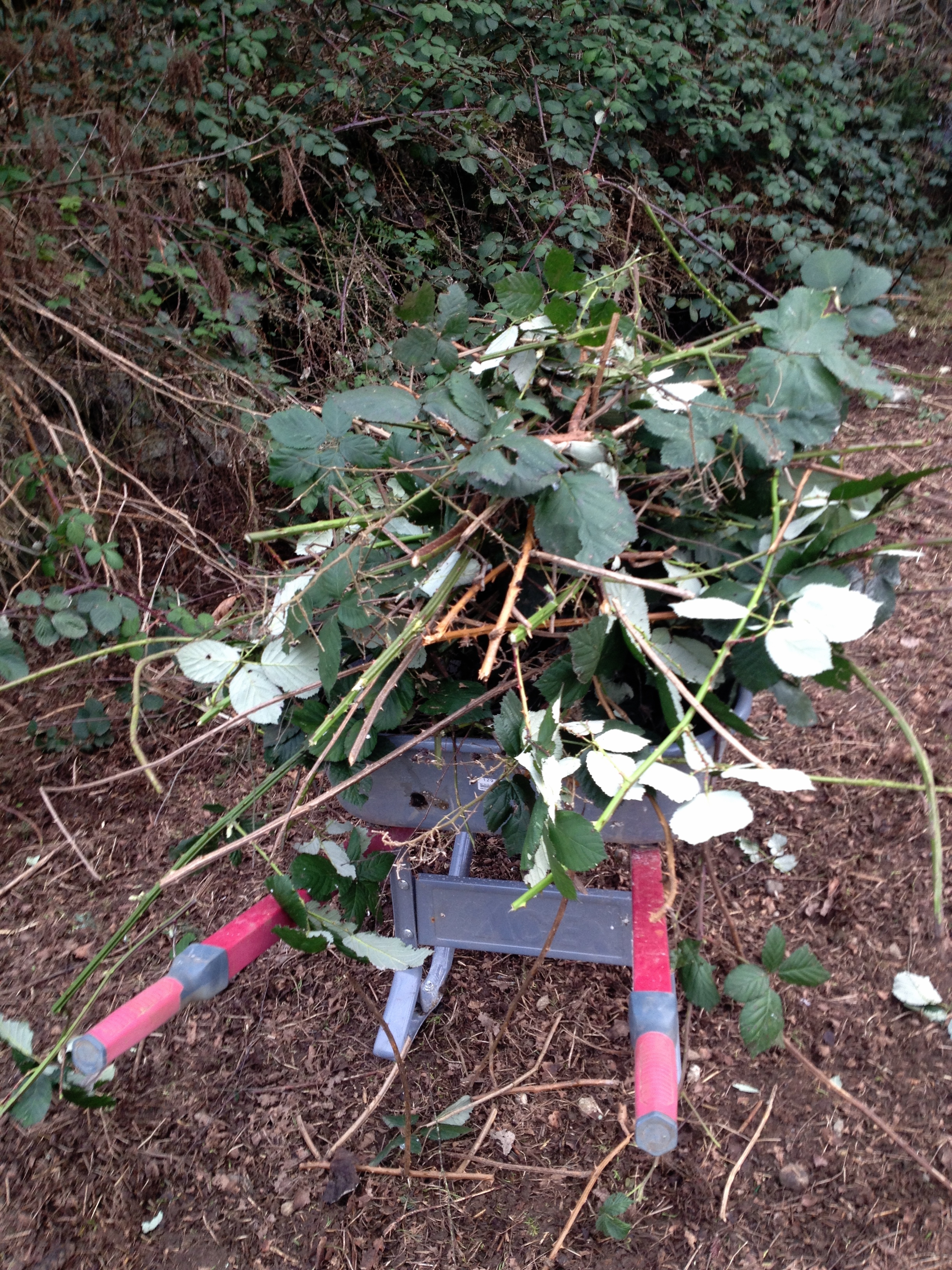
Is there anyone who is happy about this abundance of invaders? Indeed, yes – the goats! Unfortunately, the area we are clearing at the moment isn’t one that I can easily fence or we’d just let the goats come in and strip the canes. They happily wade right into the nastiest of thickets, noshing all the way and will eat all but the oldest, toughest stalks when given half a chance. After they are done, the hogs are great at using their powerful snouts to dig out the roots, which they eat with gusto. Such a shame this isn’t really a livestock-friendly area. Not wanting the creatures to be left out of all the fun, I hauled several wheelbarrows full down to the goat pen and they were happy to help us out with a bit of pre-compost processing.
Alas, it’s up to us humans to first hack the beasts off at the knees and then get in there and dig out as much of the roots as we can.
 The red layers love helping whenever we are out in the garden. They race over and see what we might have dug up. They are very good at taking care of slugs and bugs and also turning over the top layer of soil while fertilizing and are great to run through garden areas at this time of year when the annuals are done and there isn’t much they can damage.
Soon, though, when we re-seed the lawn and put in our new rockery they will have to move down to the poultry field with their fancy rolling house and take their place with the other birds. I’ll miss not having them so close to the house, though it will be great not tripping over six or seven at a time as they vie for the opportunity to untie my shoelaces and peck at my calves every time I go outside!
Posted in Blog, Chickens, Garden, Uncategorized
Tagged chickens, goats, himalayan blackberries, hogs and blackberries, homestead, invasive species, small farm, weeds
 A few weeks ago I started working on a lengthy project with some students at Shoreline Middle School. Kids from grades 6, 7, and 8 are working together to create a book that highlights all the cool, green initiatives going on at their school. It turns out, there is so much going on we might need to do a whole series of books! We certainly have our work cut out for us as we navigate all the usual steps taken to get from concept (“Let’s write a book about our school!”) to the day of the official book launch sometime in late May or early June when the kids will get to hold copies in their hot little hands.
If I were to try to describe everything that’s going on at the school, I would wind up with a book and not a blog post, so I thought I’d just mention a couple of initiatives that could be implemented just about anywhere.
In the photo above the kids are not being arrested or doing some sort of push-ups against the wall. We went on a walkabout together in our early information-gathering stage of the project and the school principal stopped us in front of this wall. A little farther along, closer to the doors, a couple of raised beds contain herbs used in the school’s soup and salad bar.

As we stood there looking at the wall, the principal asked what direction the wall was facing. Several kids knew it was a south-facing wall (I was impressed because, being directionally challenged, I don’t think I could have told you which way any of the walls attached to any of the schools I attended were oriented). Immediately, a lively discussion followed about why south facing walls are great as passive solar heaters and how you can plant heat-loving things (like herbs) along such a wall to extend the growing season.
What was also cool was the way that wall acted like a kid magnet. No sooner had someone said it was likely to be warm than the whole class surged forward and touched, leaned against, and pressed cheeks and foreheads to the building. When the principal commented that there was discussion afoot about planting peach trees along the wall, well, there weren’t too many nay-sayers in the group!
And so it went as we made our way around the school grounds inspecting the vegetable garden complete with hanging woolly pockets full of strawberry plants (sleeping, but still alive), the back forest, and the school field.
 I had a bit of a shock when I glanced out the window and saw a couple of these coyotes out on the field! Turns out they are fakes, moved around each day in order to scare off the Canada Geese. They seem to be doing the trick because we didn’t see a single goose on school property all afternoon. I have the feeling that one way or another these guys will be featured in the book!
It was fascinating to see how all the earthy stuff (composting, rain barrels, growing vegetables, a camas bulb planting project, eradication of invasive species, etc.) was being recorded by kids taking photos with Iphones and digital cameras and making notes on their Ipads and other digital devices. I have to say I was impressed that by and large the digital tools were used to get the job done (collect lots of photos of our fact-finding mission) rather than send endless texts or watch cute cat videos. Can’t wait to see how things progress over the next few months! I’ll try to remember to post updates every week or so until the project is finished…
 Earlier this week we went to a Green Drinks evening. I’ve had ‘Green Drinks’ at marked down in my daytimer several times over the past while, but somehow the schedule has been so full I haven’t made it to one yet. I had thought that this was a local thing – there are a lot of green people in this neck of the woods. Turns out, Green Drinks International is a whole movement! How could I have slept through this?
From the website:
| Every month people who work in the environmental field meet up at informal sessions known as Green Drinks.We have a lively mixture of people from NGOs, academia, government and business. Come along and you’ll be made welcome. Just say, “are you green?” and we will look after you and introduce you to whoever is there. It’s a great way of catching up with people you know and also for making new contacts. Everyone invites someone else along, so there’s always a different crowd, making Green Drinks an organic, self-organising network. |
This particular meeting was held at Level Ground Trading, a local success story started up by four Canadian families “for the purpose of improving the lives of disadvantaged producers through trade.” The evening started with a short, excellent talk about the company, how it started, and how it works (coffee and tea are a couple of their main products and company members travel to the small farms and farmer collectives in countries all over the world to meet the growers, sample product, and negotiate fair trade deals). After that, we all donned aprons, hairnets, and beard nets (!) and set off on a tour of the coffee roasting facility.

Dad in his beard net, a sight I never thought I’d see!
Our tour guide, Stacey (one of the founders), was passionate and knowledgeable about his subject, which made for a fascinating evening.


![IMG_8006[1]](https://darkcreekfarm.com/wp-content/uploads/2014/01/img_80061.jpg)
The sacks used to transport coffee beans are destined not for the landfill after they are empty, but for local gardens and farms where they are used as mulch and over paths between beds. Fully biodegradable, they compost and disappear completely within a year. The whole facility is garbage free (as in, they send nothing to the landfill). This was a side note in the presentation but seemed to be typical of a company that appears to be trying hard to operate ethically and sustainably.
Posted in Blog, Food and Recipes, Markets and Special Events
Tagged beard net, coffee, dried pineapple, green drinks, level ground, tea
Oh. My. Busyness. Thank goodness it is still Wednesday and I can get away with posting a couple of recent photos of the dogs and my wayward piglet bonding. Such shenanigans are over for the moment as I have fixed the hot wire, but the inter-species chit-chat was entertaining while it was going on!
[For regular blog followers, note this series was shot on the same day that Fritz Frizzle disappeared… you can see him scuttling off into the distance in the animated gif…]

Pippi, Tuulen, and the adventurous piglet, bonding

“I want that apple!”
“No, I want that apple!”
“My apple!”
“No! My apple!”
The piglet won this little contest, btw – a moment later she snatched up the apple and retreated a few steps, where she gulped it down. This, of course, sent Tuulen into a fit of whining and complaining and shooting me looks that clearly said, “How do you expect me to compete when I’m tied up?!”
Tagged animal interactions, dogs, hogs, homestead, Large black hogs, Piglet, small farm





 darkcreekfarmdotcom