Category Archives: Art

Death By Falling Rock – and Art a Century Later

According to the Haig Pit Mining and Colliery Museum, In 1913 70000 horses were working underground in the UK.

According to the Haig Pit Mining and Colliery Museum, in 1913 70,000 horses were working underground in the UK.

When I was little I used to listen with a mix of horror and fascination when Dad told me stories of the pit ponies used to haul rail carts laden with coal from the mine in Ryhope (near Sunderland). His father was a harness maker and was responsible for making and repairing harnesses used by the ponies (along with other leather items) and as a boy Dad remembers visiting the stables where the ponies were kept. I remember being horrified at the thought of the ponies working underground in the dark for years and years, and heard the stories about how they went blind once returned to life above ground. It turns out that perhaps this wasn’t entirely true, that ponies were not blinded as a result of having their retinas burnt out but rather were injured by falling lumps of coal or rock. Nevertheless, this image of ponies emerging into the light, blinking once or twice in the blazing sun and then going blind haunted me for years, as did the thought of being trapped underground or, even worse, being crushed in an imploding coal seam.

William Stratton's grave in Merton

William Stratton’s grave in Murton, Durham

Perhaps there is some genetic memory at work or perhaps my father was just really good at telling horrifying stories, but it turns out that my great grandfather (William Stratton – whose sister married into a branch of the Wordsworth family…) was hewing coal in a shallow seam at the mine in Murton when a boulder-sized chunk of stone and coal broke free and crushed him, killing him instantly. Dad found the mine accident report of the death which states,

When he was hewing in Low Main Seam a stone fell from between slips, killing him instantly. 

stratton grave 03

William Stratton was 34 and left behind a wife and six children including my infant grandmother, Mildred. Though Granny never knew her father, his story passed through her to my father and then on to me. William was hewing coal, lying on his side wielding a pickaxe in a seam that may have been as shallow as 15″. Granny recounted, “[At the funeral] he looked as if he had just come out of a band box. He was a handsome man with auburn hair.”

Coming out of a band box was, apparently, a description of someone whose face was untouched, as if taken out of a hat box, in pristine condition. At 34 he would have been in his prime.

Hewers had a nasty job, hacking away at the face of the coal seam, scraping the coal behind them where it was picked up by a marra (workmate) who then loaded the coal into a tub, a cart that ran along tracks and was pulled out of the low, narrow tunnels toward the surface – often by the pit ponies. Miners were paid by the tub and the loads were counted twice – once by a representative from the mine and once by a check weighman, an ex-miner (often injured) who also counted tubs and checked the weights of coal to make sure the tallies were correct. According to Dad, another of our relatives was a check weighman after he lost several fingers in a mining accident.

Dad remembers there being 500 pit ponies at work in the mine in Ryhope and when he would accompany his father home from work at the pit the two of them would stop to feed the ponies hay, stroke and brush them. “I loved the ponies,” Dad says, fondly recalling his visits to the stable.

These mining memories have come up recently for a couple of reasons. First, I get really creeped out when underground and though I really want to do some spelunking, the thought of being down there somewhere when an earthquake hits or some narrow crawlspace proves to be too narrow to get back out again fills me with dread. Even when I was having the time of my life playing on Virgin Gorda I had moments when my stomach clenched and I had to force myself to breathe normally and not think too hard about those massive boulders shifting, cracking and toppling, pinning me down there somewhere never to be found again.

Bouldering on Virgin

Bouldering on Virgin Gorda was one of the highlights of our trip to the BVI but part of me couldn’t help wonder what would happen if one of those rocks decided to shift and topple at an inopportune moment.

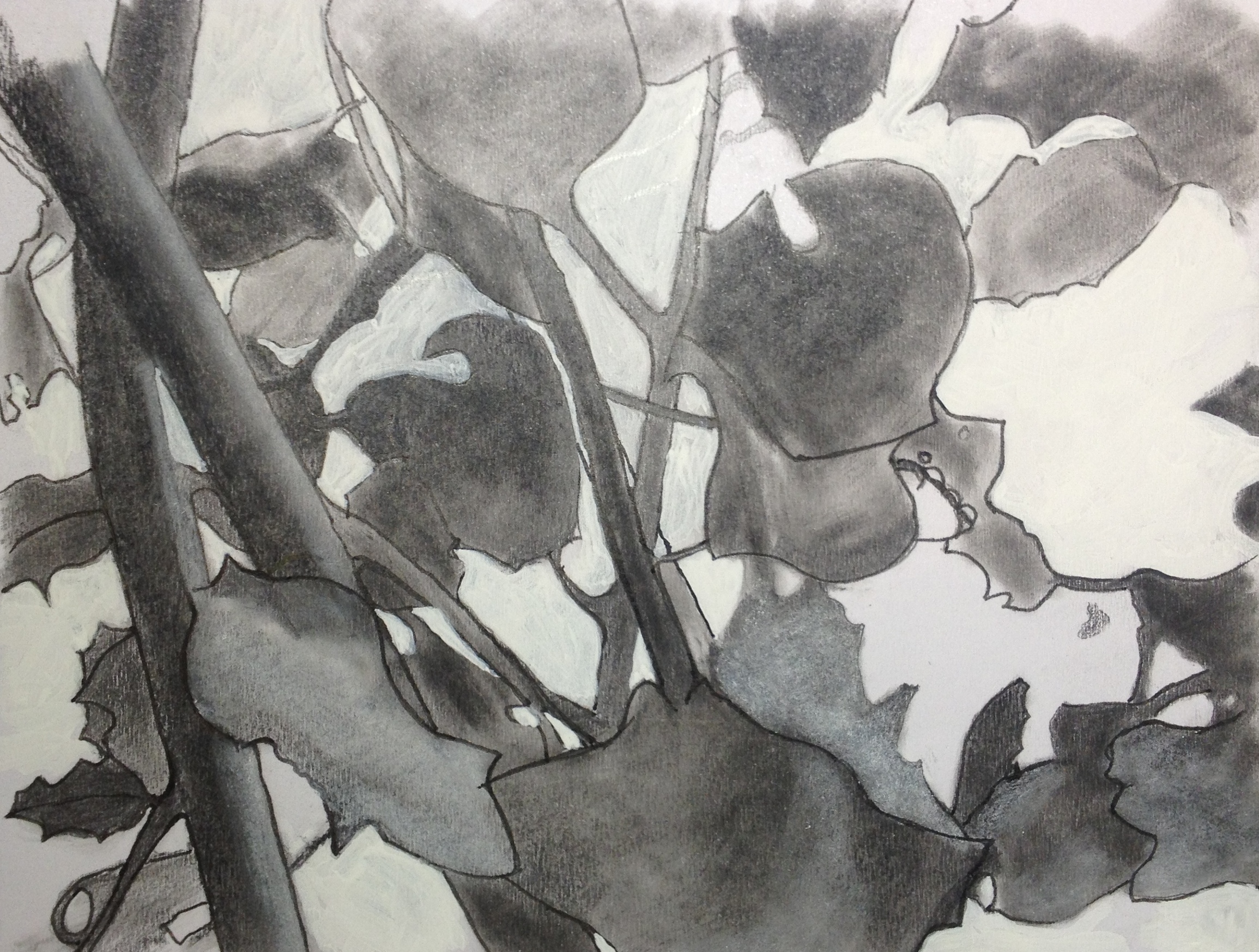
The other reason we’ve been talking about mining accidents is that Dad is at work on a series of coal mining paintings, an homage to his fallen ancestors. Our Olympic rowing team neighbour graciously posed (on the ground, with a pickaxe) for Dad. Sketches and watercolours are underway, all preparatory for work in oil… I’ll post as progress is made.
Japanese Maple

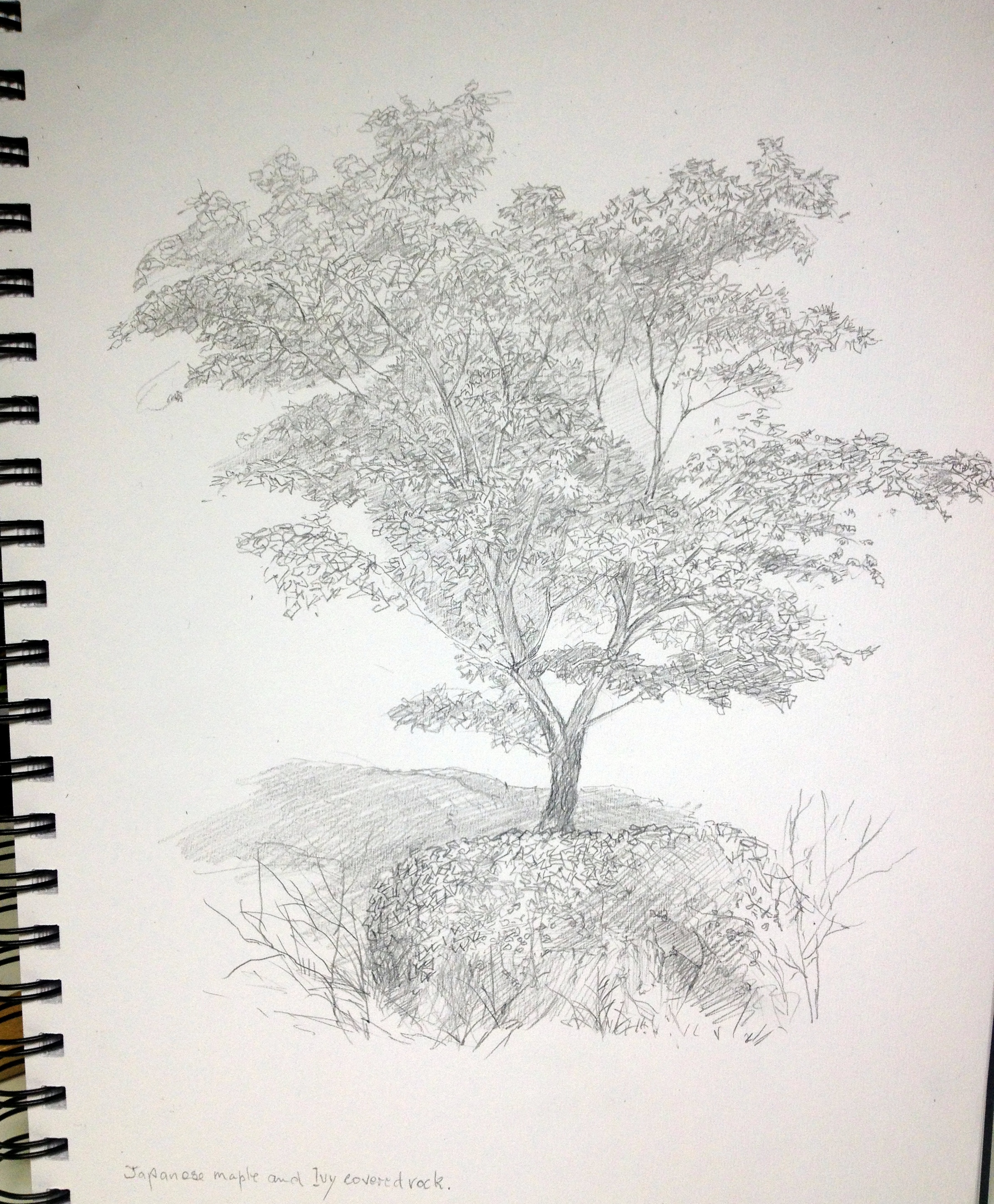
One of the first ornamental trees we planted when we moved here was a Japanese maple – two, actually. One has stayed tiny and red, the other has become a giant (for the diminutive maple). Both Dad and I have always liked the delicate leaves and interesting forms of these trees.

Japanese Maple by E. Colin Williams

Japanese Maple by E. Colin Williams

While Dad has been sketching away in his studio, I’ve been a regular at the library, checking out various books about trees including a couple by Thomas Pakenham. In the book, Meetings with Remarkable Trees I found lots of odd information about trees with strong personalities. The photos and artwork in the book are inspiring and do, indeed, capture something of the individual nature of trees. What was perhaps the coolest thing, though, was the way a previous patron had pressed leaves between many of the pages.

Leaves, mostly maple, have been carefully pressed between the pages of this library book about trees...

Leaves, mostly maple, have been carefully pressed between the pages of this library book about trees…

So what should I do, librarian friends? Do I leave the leaves alone and let someone else have the pleasure of finding them? Or do I remove them because maybe it isn’t such a good idea to have fauna lurking inside library books?

The Holly and the Ivy (and the cabbage and the cigarette)

Dad is having his revenge. Today as we were driving to the local raw food/wrap shop to pick up scraps for the pigs, chickens, turkeys, ducks, et al (yes, there is still some farming going on around here) he started singing the old English Christmas carol, The Holly and the Ivy and then launched into a list of factoids relating to holly (evergreen, red-berry-bearing and manly) and ivy (evergreen, sinewy and feminine). The fact both plants are green in the depths of winter is reason enough to celebrate them in song, but what was really interesting was the way each had been assigned a gender.

Holly Tree by E. Colin Williams (Tree a day drawing project)

Holly Tree by E. Colin Williams
(Tree a day drawing project)

This tradition of association with one gender or the other was taken to some strange lengths back in the day. According to Dad (and his online sources), ancient Brits (as in, folk of the British Isles who lived long, long ago – not doddering fools living in Leicester) used to hold singing contests when there wasn’t much else to do when the days are short and frosty. It was the men against the women, singing their hearts out in praise of their respective shrubbery, dissing that of the opposition. All, of course, was done in good fun and, apparently, at the end of these vocal feuds everyone kissed and made up under the mistletoe.

Hm. I was still pondering all this when Dad mentioned a powder room and I immediately thought of a small room in which British types powdered their noses and otherwise readied themselves for well-mannered conversations with other primped and prepped pommies. “They were lined with copper,” Dad was on a roll and, as I was imagining what fancy powder rooms they used to have, he was chatting on about how the fine sailing vessel HMS Victory (the one Lord Nelson sailed into the Battle of Trafalgar) was made with wood from 6,000 oak trees and did I know that it was the oldest-still-in-commission ship in the British fleet and currently serves as a museum ship… All of this was coming at me rapid fire as I was driving and, I confess, I was still struggling to understand why anyone would line a powder room with copper.

“So, why did they line them with copper?”

“Because of sparks.”

At which point I burst out laughing because, of course, Dad was talking about powder rooms in old wooden gun ships where, yes, sparks would be a bit of a problem with all that gunpowder lying around. And I was thinking of little old English ladies who had consumed one too many helpings of cabbage and then slipped off to the powder room for an illicit cigarette.

This Month, it’s All About Trees

There is nothing like a deadline to inspire a burst of creative energy! My newest book (co-written with my daughter, Dani) has just come out and we are busy planning a cool book launch, hopefully in partnership with the kids at Shoreline School (stay tuned – more on that as the plans come together).

New book!! It was cool to work on a project like this with daughter, Dani...

New book!! It was cool to work on a project like this with daughter, Dani…More info here

Meanwhile, though, the next book (also in the Footprints series) is well underway. The subject of the book is trees, which means I’ve been driving friends and family mad recently by babbling on and on and on about baobabs and canopy scientists, corduroy roads and carbon sinks. In some kind of self-defense move, Dad piped up the other day and told me he was doing a tree-a-day drawing challenge. “Remember how you used to do that blog a day thing?” he asked pointedly. “Like that.”

Okay, okay – it has been BUSY around here this summer, too busy, apparently, for me to sit at the computer and blog on a regular basis. Well, at all, in fact. But here we are with the seasons shifting once again. The evenings are longer and there is hope that I can find some inside time to get to projects like the blog.

Trees herald the change of seasons with such... intensity!

Trees herald the change of seasons with such… intensity!

Given that I am obsessing about trees anyway, Dad suggested I write a little something about the trees he is capturing on paper. Which seemed like an excellent idea until I saw that his first subject was a Garry Oak. “They are so gnarly – all those twisty branches,” Dad explained when I asked why he had picked the Garry Oak as his first subject for the series.

Garry Oak Trees by E. Colin Williams (drawing)Garry Oak Trees by E. Colin Williams (drawing)

To an artist I guess twisty and gnarly equals interesting and challenging to draw, but I must confess that Garry Oaks are some of my least favourite trees! (Sorry, sorry to the Garry Oak lovers out there – and, no – it absolutely was not I who poisoned Margaret’s lovely old tree – THAT tree is special… and, yes – there are maniacs out there who go about drilling holes into the roots of gnarly old trees all the better to inject them with tree-murdering toxins! Note to self: subject for a future post…silvacide.)

Garry Oak ecosystems are fragile and rare, so much so that there are armies of volunteers out there who are working diligently to preserve the trees and their immediate surroundings [for more information on this work, visit this website and have a look at the amazing resources they have made available]. Garry Oaks (Oregon White Oaks) live in western North America close to the Pacific Ocean. Their range is limited and threatened by urban and agricultural development and linked to a whole community of native species threatened by all manner of invasive species like Scotch broom and Himalayan blackberry. Given my propensity for cheering for the underdog, it’s a bit surprising I don’t know more about them. Hm. I sense a shift in attitude is already in progress…

What about you? Do you have a favourite kind of tree? A least favourite? What is it about some trees that makes them so appealing? Or, unappealing as the case may be…


Weekly Photo Challenge: Abandoned

What is it about abandoned buildings that is so compelling? Given that the theme of this week’s photo challenge is ‘abandoned’ I’m obviously not the only person to think so. I find abandoned buildings sad and lost – and can’t help wonder about their stories and the stories of those who lived/worked/died there.

Dad is the same way – over the years he has painted many decrepit old barns and derelict buildings of all shapes and sizes. A few years back he was fascinated by the facade of one of Victoria’s old brick buildings that had carefully been salvaged and propped up prior to the property’s redevelopment. The project had been in limbo for a while when he started working on the painting and we captured all the stages of its development in this short (less than a minute) time-lapse photo video.

Partway through you can see two figures appear – and though the whole painting is interesting and full of intriguing details, it is their presence that I am most curious about. What are they doing? Who are they? What are they talking about?

Depending on my mood and how optimistic I am feeling about the world, they are two heroin addicts finding a quiet corner to shoot up – or they are activists scoping out the empty lot as a possible place to do a bit of guerrilla farming – or, they are young lovers who just wanted to sneak away from their respective day jobs for a quick snuggle…

Preservation

If you click on the link to the image (for some reason, I don’t have a copy to upload from this computer) you can zoom in on different areas to better read the graffiti, etc. If you have a closer look at the seated figure you might notice some similarity to yours truly… Dad had me pose (out on the deck, if I remember correctly) and then based that person (druggie/world-saver/hussy?) in the painting on the photos and sketches.

The process wasn’t unlike what I do when I create fictional characters in my novels – I am often inspired by real people I meet and then plunk them into some alternate world and make them hang out with people they would never meet in their actual lives. The fact I am sort of in this painting does nothing whatsoever to help me know the story behind whatever conversation it is those two might be having… and Dad isn’t saying.