NABLOPOMO – Yikes! The Season is Full Upon Us!!

Oh. My. Goodness. As I had feared when I embarked upon a month of daily blog posts in DECEMBER (!!), an avalanche of activities has caught up with me!Feeling festive!Feeling festive!

Last night, a holiday potluck with farmers and Peninsula Agriculture Commission folks, today testing a new (to me) turkey recipe, fighting with writing deadlines (a couple of them!), and all the regular farm stuff… Tomorrow we are hosting a bit of a get together here before heading next door where the neighbours are hosting a bit of a get together there… Sunday we are sorting hogs (weaning both litters together) and I’m hosting a meeting here, My fingers are crossed that the piglet sort goes reasonably smoothly so they are settled in new digs BEFORE my meeting begins! Tomorrow morning I also need to get a load of hay and keep working on the writing projects… With all that going one, ack – the blog is likely to be a bit thin over the weekend!

What I don’t need to do is bake cookies. Not long ago we hosted a cookie swap (which is, by the way, the BEST thing ever for someone who loves cookies as much as I do).

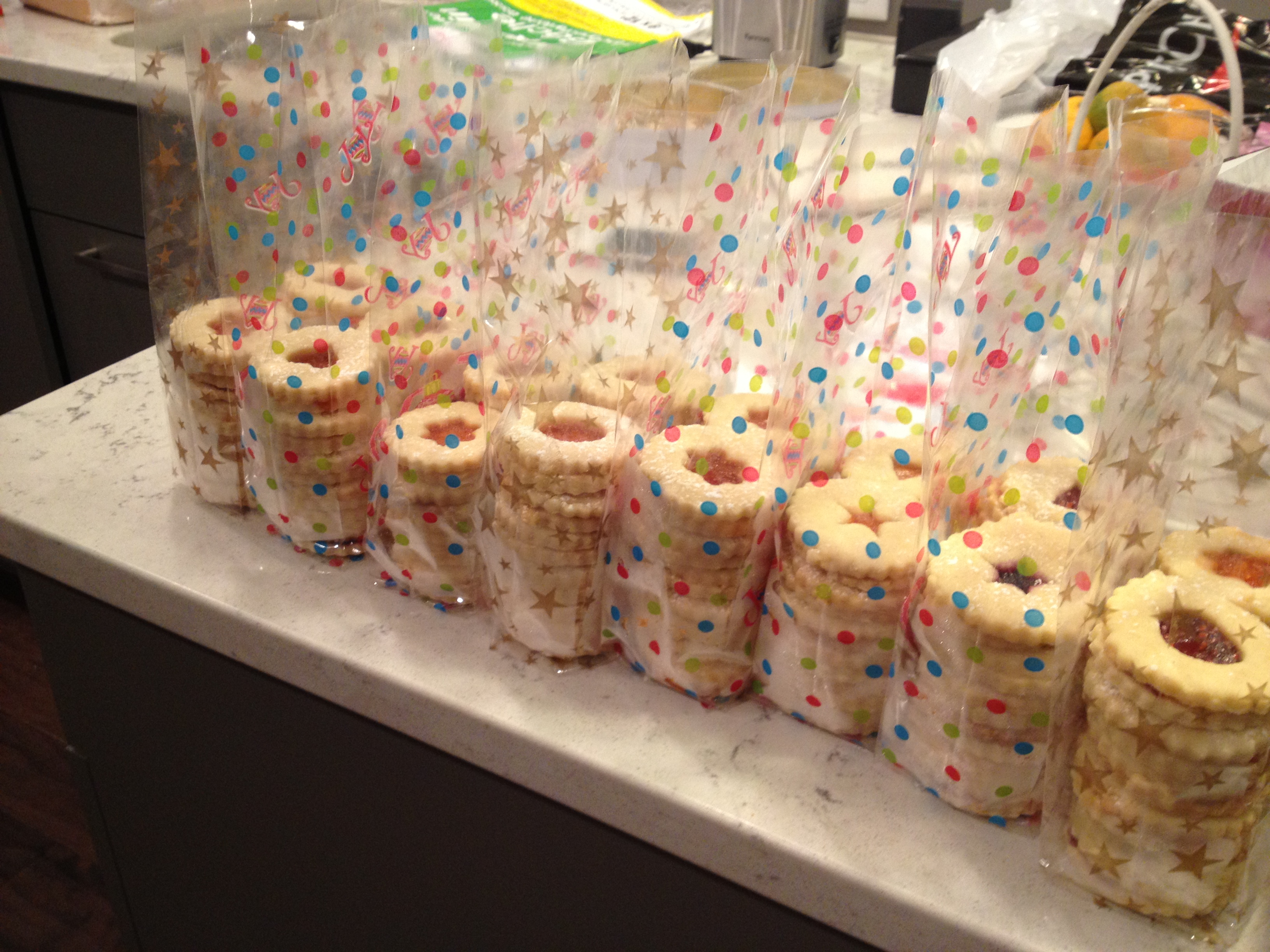
Each person who came to the cookie swap brought a baker's dozen dozen cookies... We then mixed and matched and each left with a dozen each of a dozen different kinds of cookies. Yum!  These were Dani's sugar and jam delights... I made chocolate dipped macaroons.

Each person who came to the cookie swap brought a baker’s dozen dozen cookies… We then mixed and matched and each left with a dozen each of a dozen different kinds of cookies. The extra dozen of each variety was set out for testing… Yum! These were Dani’s sugar and homemade jam delights… I made chocolate dipped macaroons which are guaranteed to transport me back to my childhood when my Omi used to make them as a special treat at this time of year.

Other than macaroons, I am a big fan of plain old sugar cookies with a bit of almond flavour (another Omi special). Omi was also a fan of making a batch of vanilla dough and a batch of chocolate, rolling them out, stacking the rolled out slabs one atop the other, rolling both up together and then slicing the cookie dough logs. The result was very yin and yang and absolutely delicious!

What’s your favourite cookie recipe?


NABLOPOMO – We should be doing more of this… mending, that is.

Dad recalls all kinds of slogans from the war and post-war years. "Make Do and Mend" was one of them.

Dad recalls all kinds of slogans from the war and post-war years. “Make Do and Mend” was one of them. [E. colin Williams]

Sometimes I think my life must seem incredibly boring to other people. I don’t actually know anybody else who obsesses quite so much over things like buckets of water! If you are fed up with the subject, move along!

The hog water troughs have long proved to be a challenge – the pigs love to dump them over, climb into them, fill their mouths with dirt and then rinse and spit into them…

The ducks are the only creatures who are perhaps even worse at fouling (fowling?) containers of water. They blow their beaks under water to clear out the mud and sludge they accumulate while sifting through sludge looking for… whatever they are looking for. Anyway, between that delightful habit, their incessant splashing and dunking, and the liberal amounts of poop they deposit while they are busy floating around in places they don’t belong, they make a mess of the hog water quicker than you can say, “[Duck] Bottoms Up!”

With all that in mind, I decided to try a new watering system for the hogs. Inspired by a similar set-up over at my neighbour’s place, I bought a hog nipple and a couple of threaded bits so I could convert a garbage can into a covered watering system.

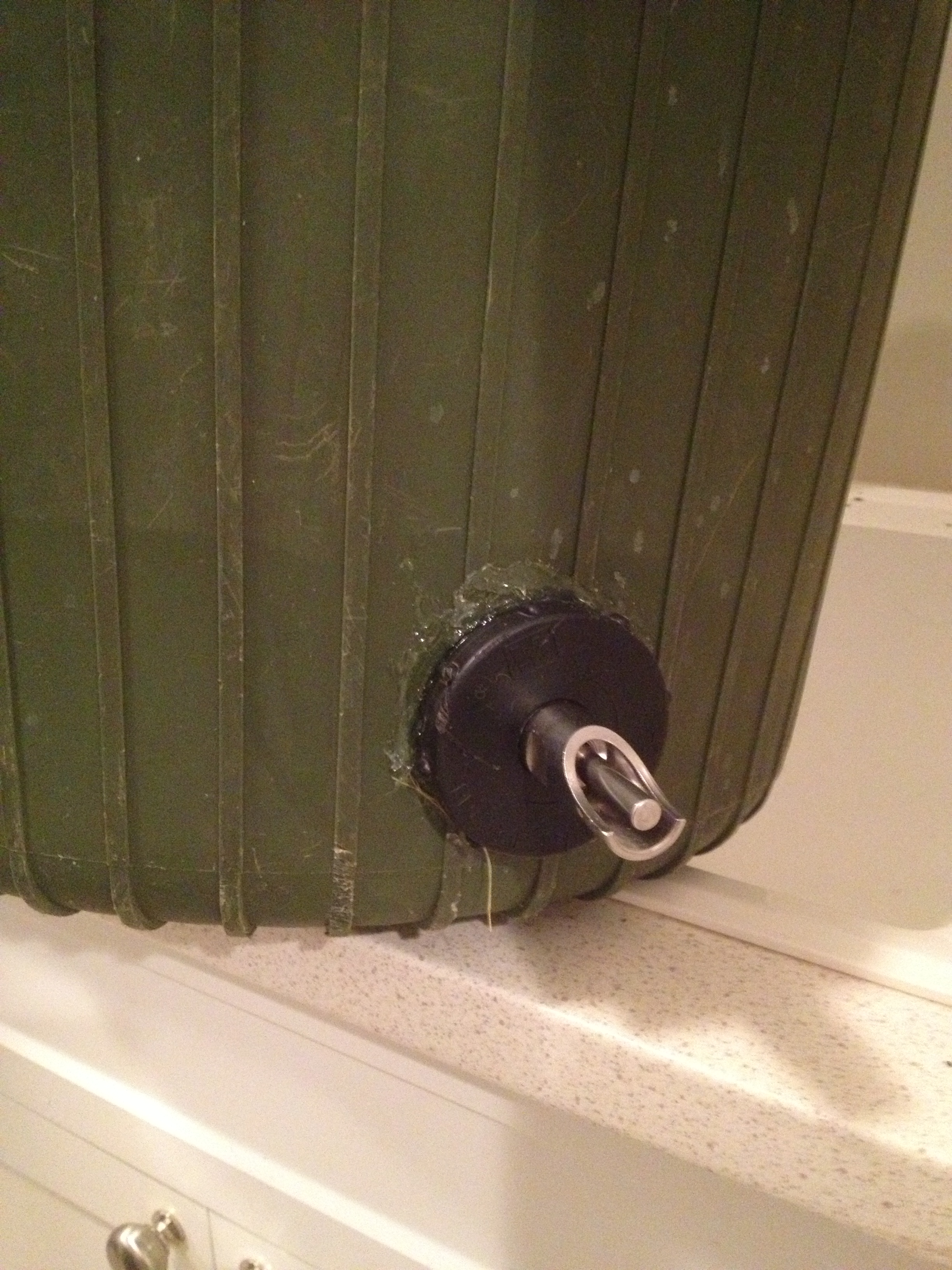
Dad and I set about installing what appeared to be a pretty simple set-up. We wrapped all the relevant threads in plumber’s tape, drilled a big hole in the side of the plastic garbage can, and then proceeded to fasten all the bits together. We screwed the hog nipple into Part A, put Part A a on the outside of the garbage can and then threaded Part B onto Part A, but inside the garbage can, sandwiching the wall of the can between the two parts. Sounds ludicrously complicated but was actually very simple.

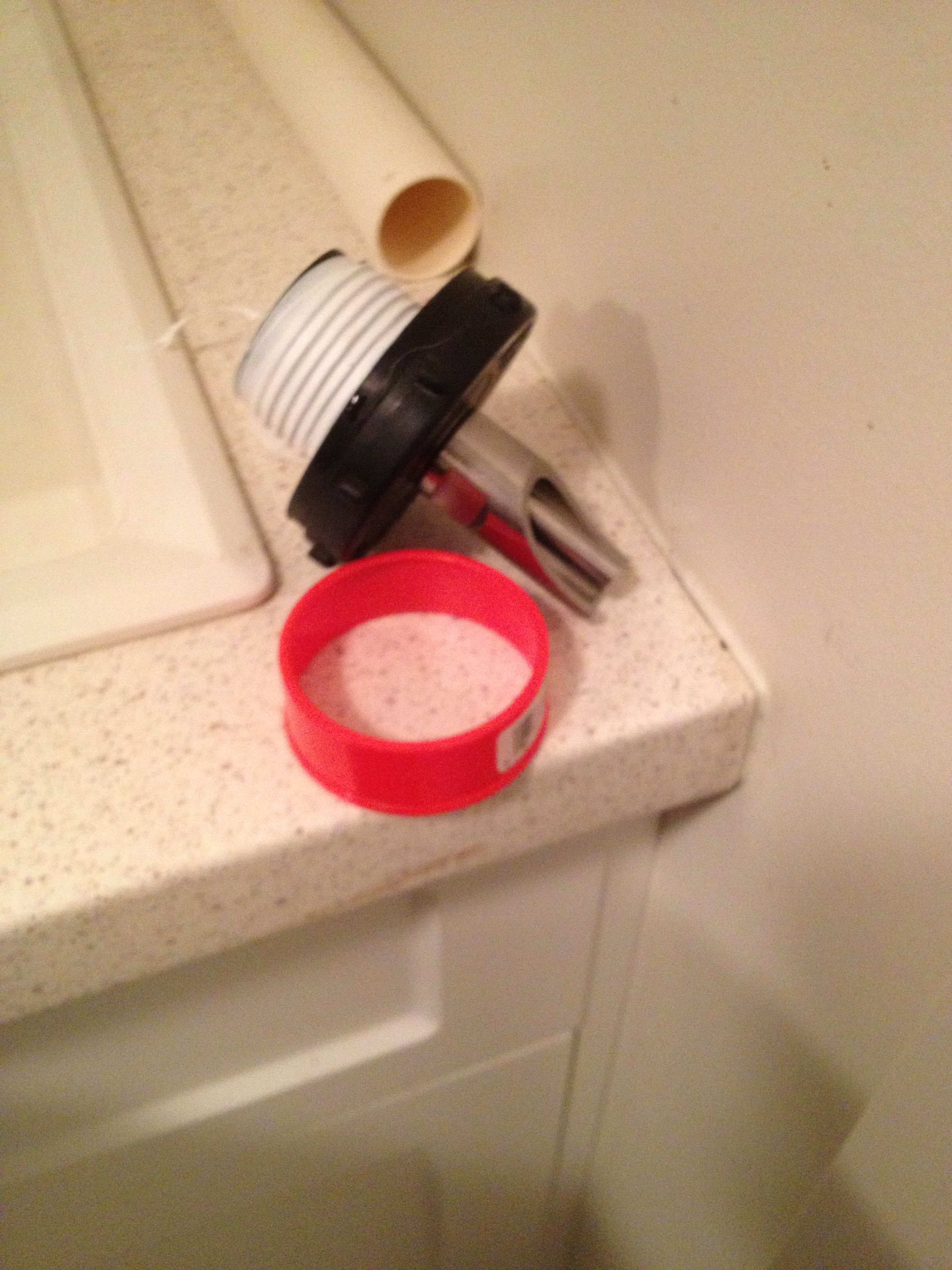
Hog nipple screwed into Part A. If only I'd paid more attention at the farm supply store as to what Part A was actually called... Threaded collar into which a hog nipple is inserted...

Hog nipple screwed into Part A. If only I’d paid more attention at the farm supply store as to what Part A was actually called… Threaded collar into which a hog nipple is inserted… The red ring is the outside cover of the roll of plumber’s tape.

We put some water in the garbage can so it just covered the new hog nipple installation and went and had dinner.

Testing the seal...

Testing the seal…

When we returned to check on the water level, it had dropped to just below the ring. We figured we didn’t have a good enough seal, perhaps due to the ridges on the garbage can, so we dug out our our handy dandy Roof Patch stuff and applied it liberally.

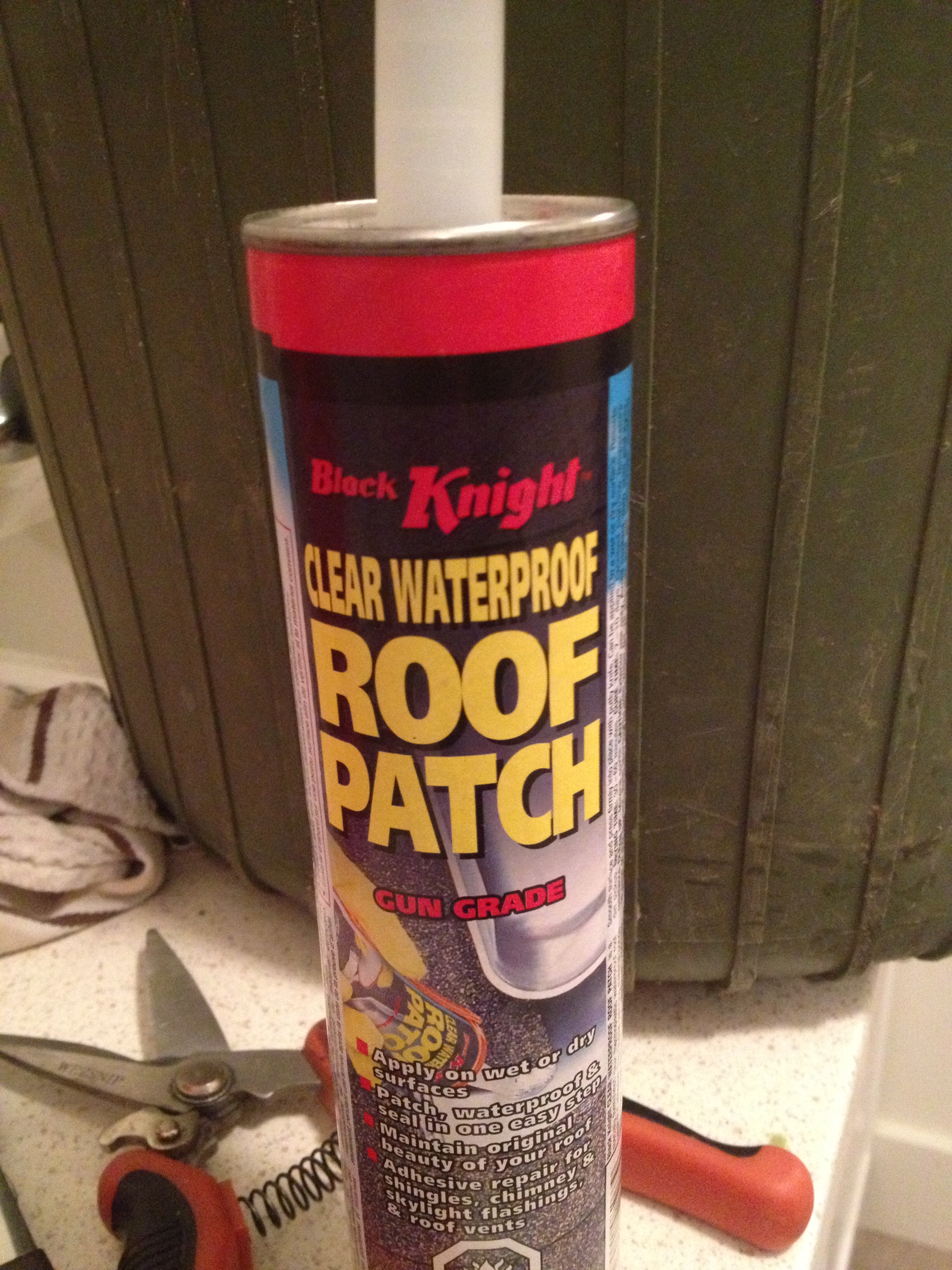
Roof Patch goop - can be applied wet - guaranteed to stop leaks. We also added more plumber's tape for good measure.

Roof Patch goop – can be applied wet – guaranteed to stop leaks. We also added more plumber’s tape for good measure.

Roof Patch goop

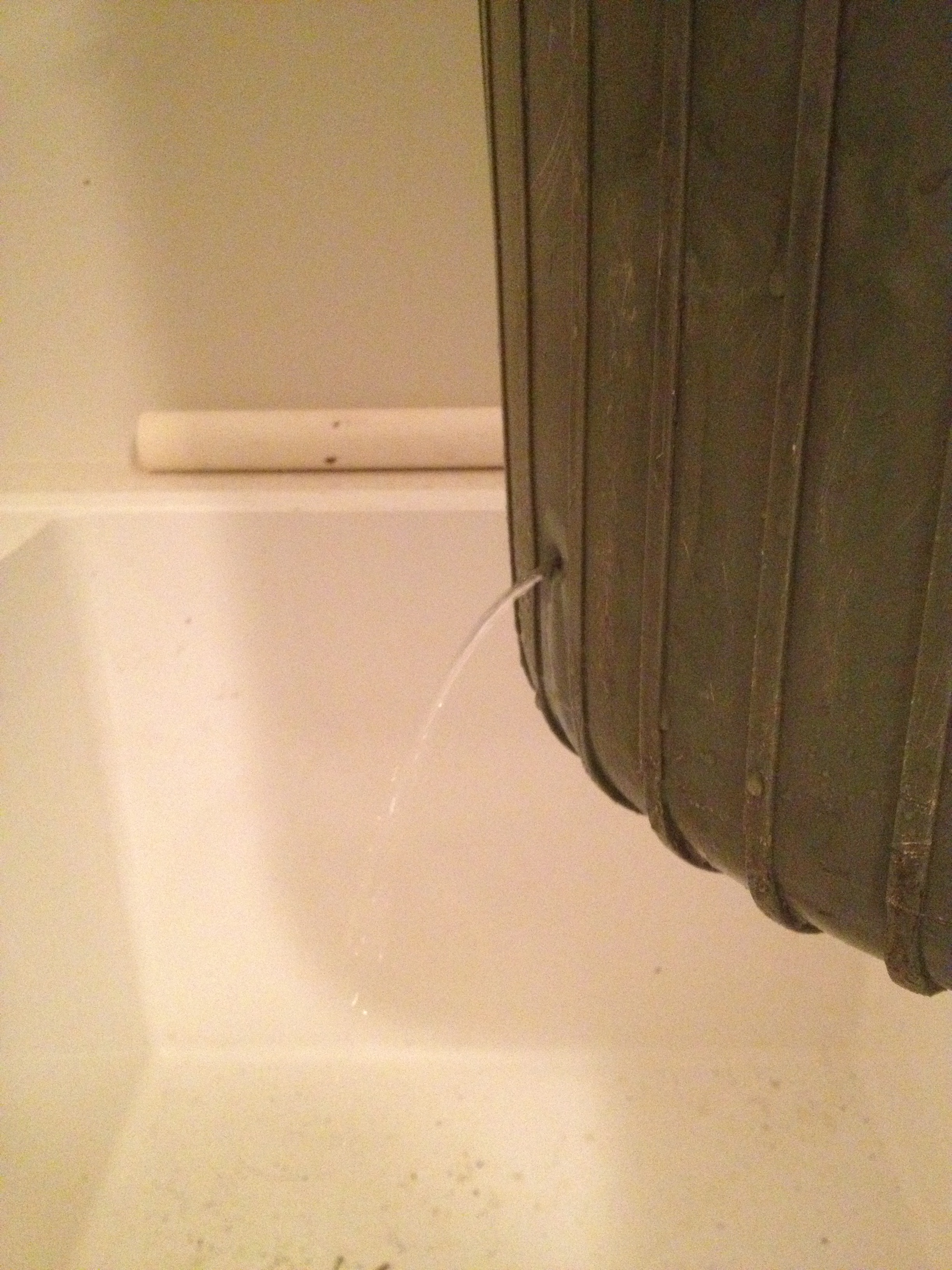
We repeated the water test and… noticed that the water level was dropping even more rapidly. Not only that, there was the distinctive sound of water dribbling… A closer inspection revealed that the problem had nothing to do with the nipple installation but everything to do with a nail-sized puncture wound on the back side of the garbage can!

How did we miss this hole the first time around?

How did we miss this hole the first time around?

At this point in the proceedings Dad had a nostalgia attack.

“”What we need here are pot menders.”

This elicited a blank look from me. Pot menders? Who mends pots, anyway? Apparently, during and after WWII, all of England was told to mend their pots by none other than the Queen.This was done using something called pot menders. The following image showed up in my email inbox at 2am that night as Dad thought he was losing his mind and remembering something that never existed.

Photo by ijbison on Flickr

Sure enough, these double washer-type doohickeys were fastened together on either side of the hole in the kettle or pot, fixing the broken item. It occurred to me that these days if my kettle stops working I run out and buy a new one and toss the old one in the trash bin. I don’t think you could buy anything like this any more, except maybe on E-bay and besides, I don’t think plastic would respond well to this treatment.

Needless to say, our supply of pot menders was non existent, so we cast our minds around to see if we could find another solution. Duct tape? Pond liner patches glued to the inside of the can with Roof Patch goop? Some sort of rubbery plug?

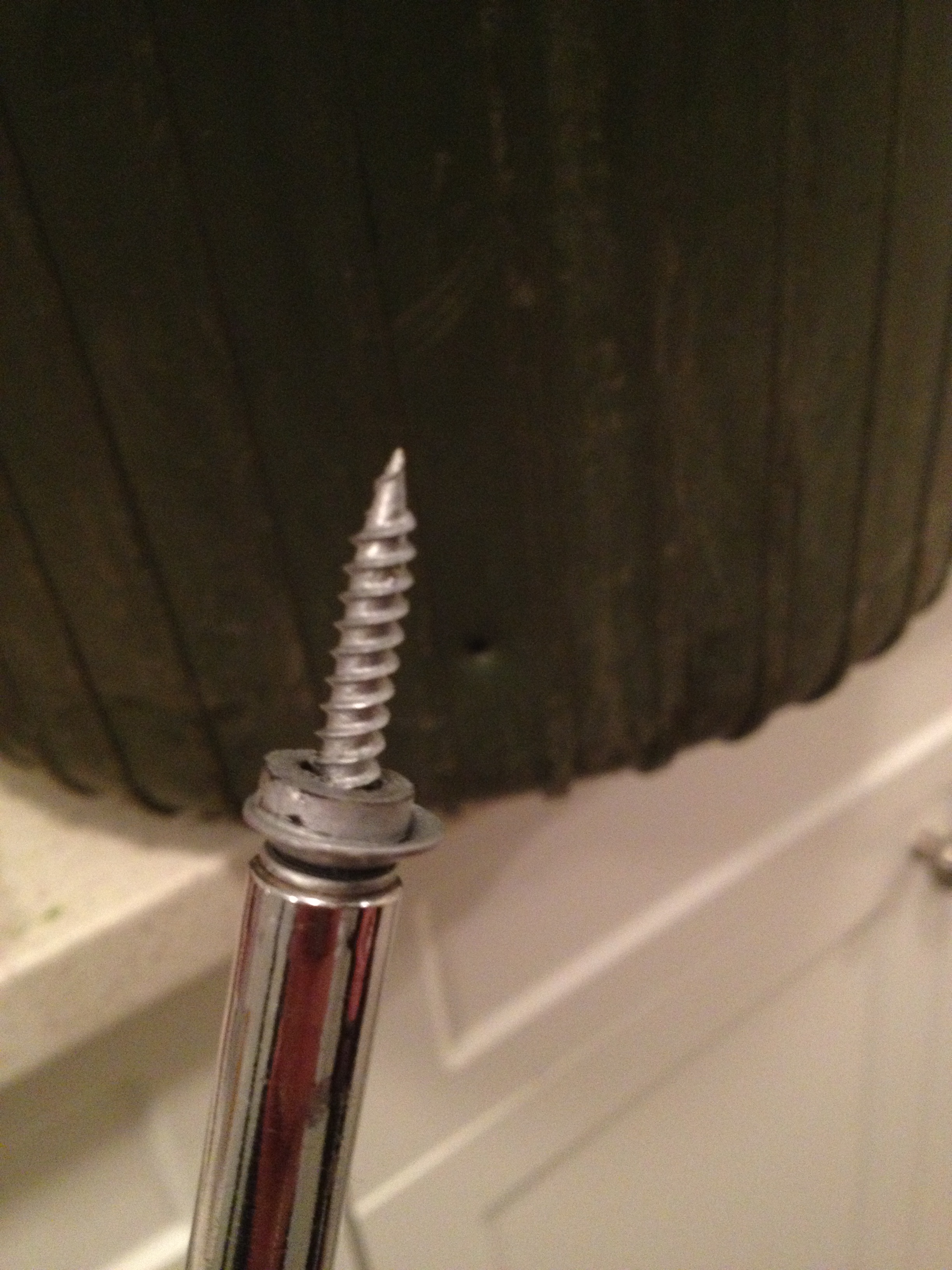
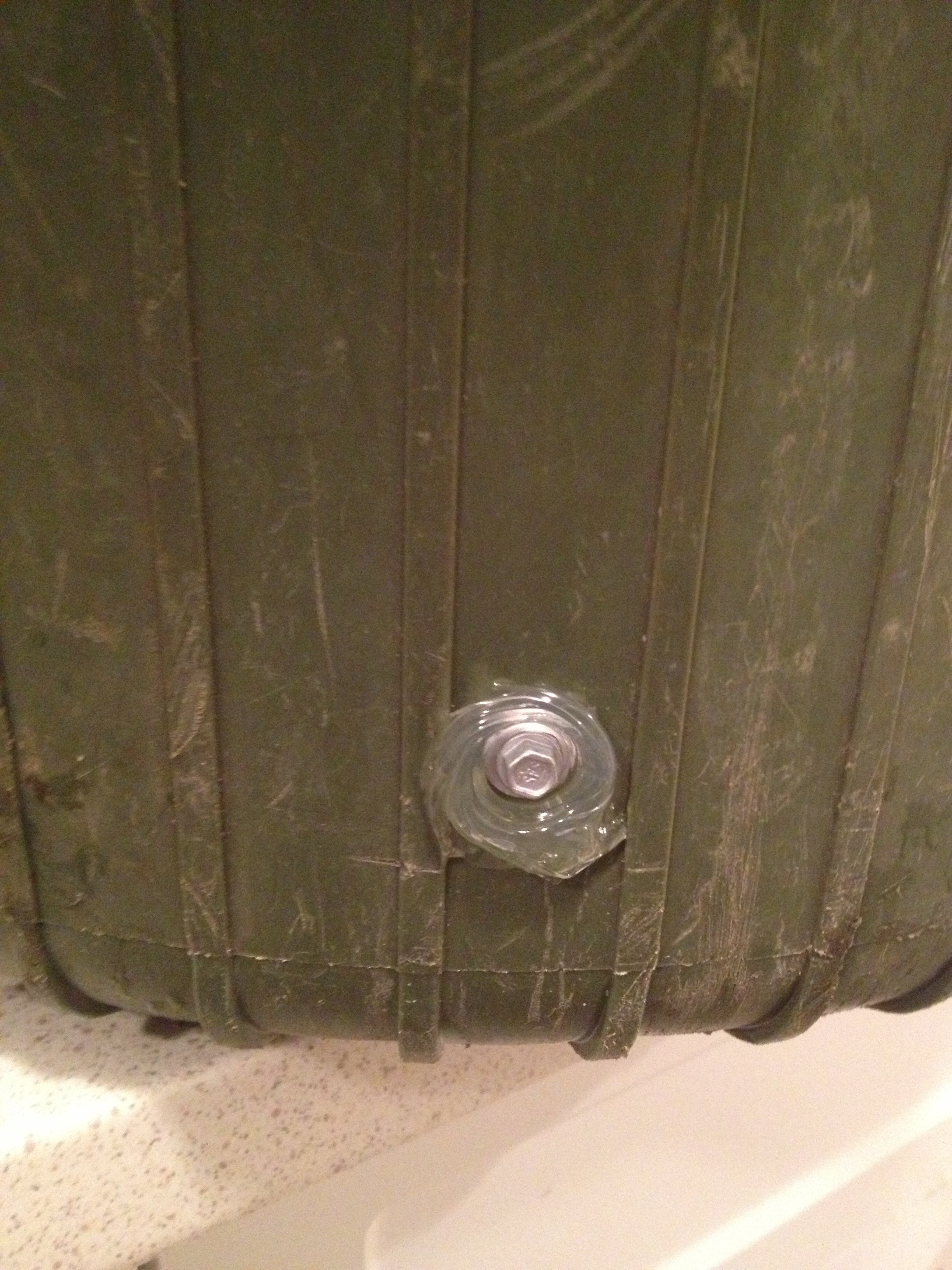
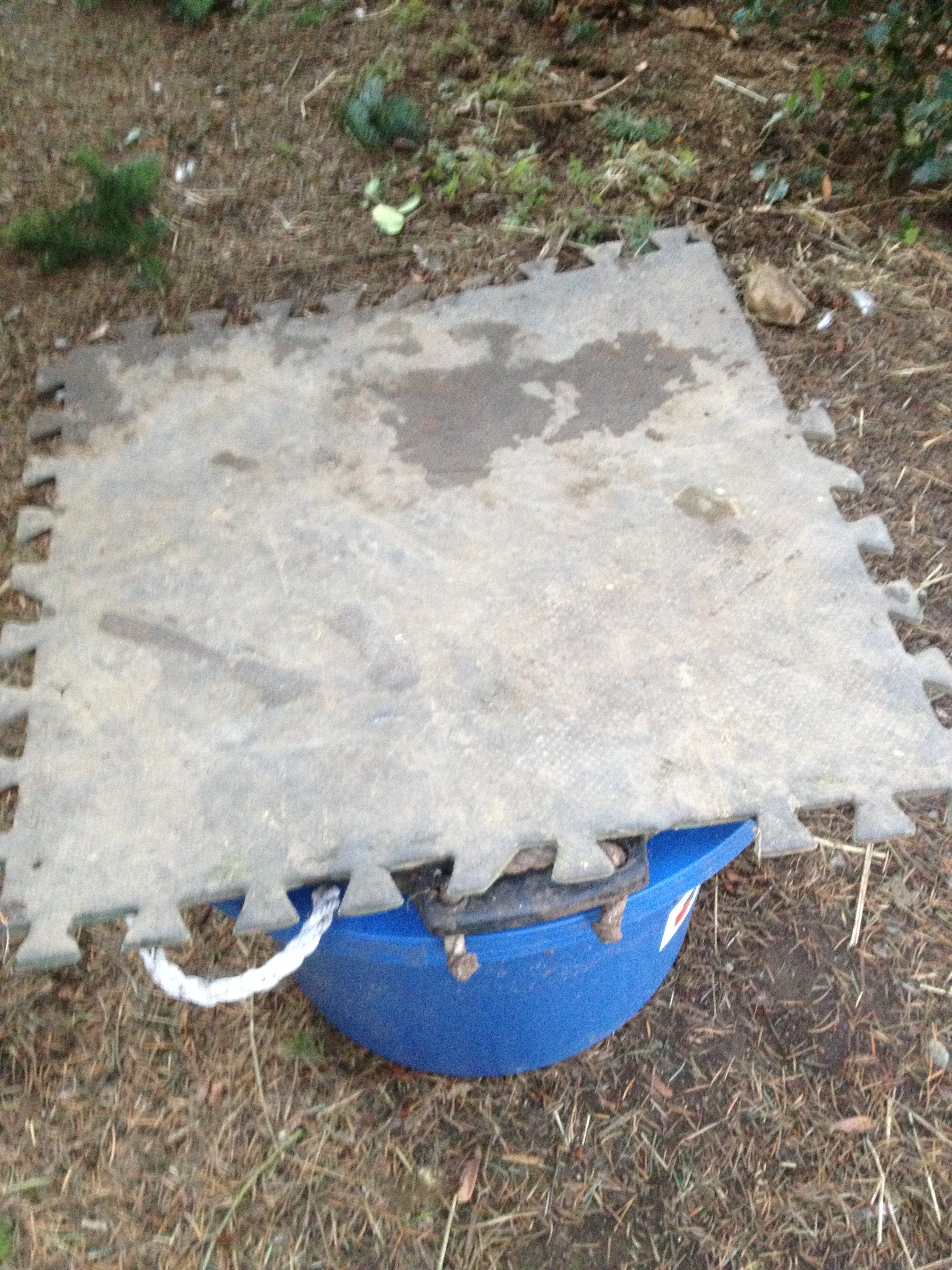
In a flash of inspiration Dad thought of roofing screws which are backed with a built-in rubber washer. We found one, slathered it with Roof Patch goop, and screwed it (gently) into the hole.Roofing screw to the rescue!Roofing screw to the rescue!Our improvised version of a pot mender in position. Our improvised version of a pot mender in position.

Ta da! Hog nipple installed!

Ta da! Hog nipple installed!

The final step was to add water and wait. The can sat overnight and we lost nary a drop of water!

The next big hurdle is installing it in the hog paddock in such a way that the hogs can’t tip it over. Stay tuned… because, yes, there is yet more to come on the subject of water containers…

NABLOPOMO – Anti-freezing Water Experiment

A duck's eye view of a pond freezing over...

A duck’s eye view of a pond freezing over…

During the recent cold snap, I was having my usual problems keeping all the animals watered. There are two main issues to deal with. First, all the water on our long, skinny farm-let originates at the top of the hill at the house. Miles of hoses with various junctions and side shoots and connectors and whatnot distribute water from the tap at the top to animal and poultry pens all the way down to the bottom of the hill. It is not practical to coil up all those hoses and drag them inside each night. Leaving them dripping works as long as the temperature doesn’t dip too low, though it does waste water and results in nasty little ice patches all over the place. The other problem is that the hoses zig and zag, go up and over obstacles and around corners and without fail, those bends and kinks are where ice blocks form, shutting down the system downstream from the blockage.

After I win the lottery (or, maybe I should try one of those crowd funding projects) I will install a frost-free in-ground water system with frost free taps all over the place… But until then, when the hoses freeze I am stuck schlepping hot water in containers from the house.

A five gallon jug of water weighs over 40 lbs. I shudder to think how many pounds I lifted during the past week!

A five gallon jug of water weighs over 40 lbs. I shudder to think how many pounds I lifted during the past week!

The water needs to be hot because the second problem that develops is the water in the various buckets and tubs freezes. When it isn’t seriously cold, it isn’t hard to smash through the layer of ice on top to get to open water below. When it stays cold for several days or when the temperatures plunge, the layer of ice is too thick to break.

This problem of the top layer freezing was addressed in the current issue of Small Farm Canada (with thanks to regular reader, blogger, and fellow farmer, Sailors Small Farm for pointing this out…). In a short how-to article it was suggested that a piece of closed cell foam insulation cut to fit inside the bucket would keep the water from freezing. The example shown was for a small pail being used  by chickens. Holes large enough for the chickens to dip their beaks in had been cut in the foam so the birds could get at the un-frozen water.

As it turned out I had some of this stuff around and thought it might work to stop the goat water container from freezing over.

A thin layer of ice just starting to form on the surface of the goat water bucket.

A thin layer of ice just starting to form on the surface of the goat water bucket.

First I roughly measured the foam – and cut it to size.

Roughly measuring the size of 'lid' needed.

Roughly measuring the size of ‘lid’ needed.

I cut a small opening on one side so they could get their muzzles in to drink.

The small opening was just big enough for thirsty goat lips...

The small opening was just big enough for thirsty goat lips…

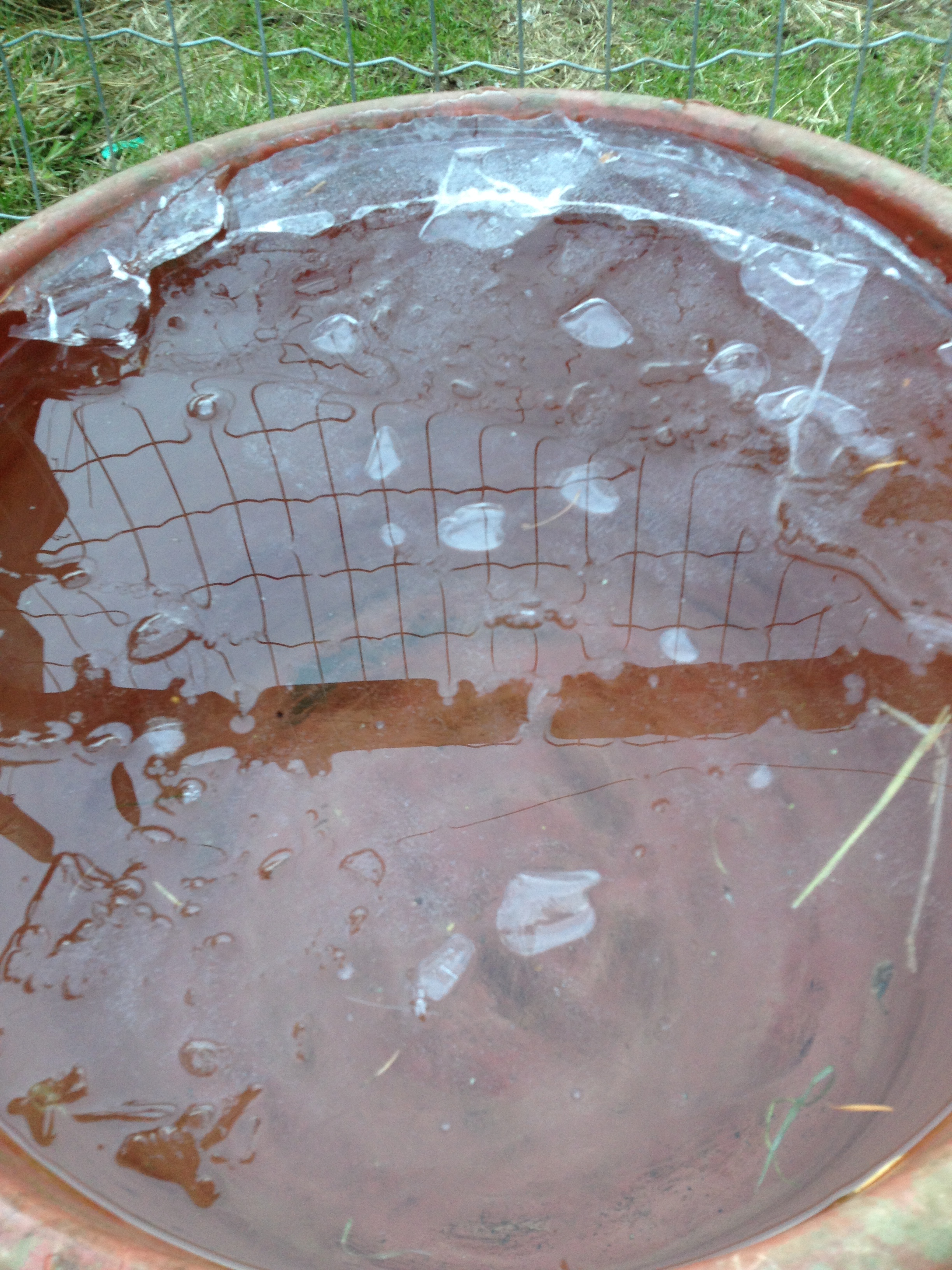
Then, I waited to see what would happen. The goats drank out of the gap just fine and immediately under the foam lid the water did not freeze. But, all around the edges, ice formed the first night. The ice layer grew thicker and it became increasingly difficult to peel off the layer of foam each morning so the goats could get at the ever-smaller water hole in the middle. By the fourth day, the foam was completely frozen into the surface and disintegrated when I tried to peel it back.The opening was the first part to freeze, which wasn't too surprising...The opening was the first part to freeze, which wasn’t too surprising…After a few days of being able to peel back the foam, it froze to the surface and came apart when I tried to lift it...After a few days of being able to peel back the foam, it froze to the surface and came apart when I tried to lift it…It was impossible to remove the last shred of insulation... I went back to the old system of pouring piping hot water into the bucket to thaw a hole and warm up the rest of the water enough that the goats would have a good, long drink. It was impossible to remove the last shred of insulation… I went back to the old system of pouring piping hot water into the bucket to thaw a hole and warm up the rest of the water enough that the goats would have a good, long drink.

The article suggests that the system is most useful inside a hen house where the temperature is right around freezing but not seriously cold. I’d have to say that when this is the case it really isn’t that big a deal to chip a hole in the skim of ice anyway. Alas, much as I had hoped this would be a great solution to my bucket-freezing problems, it seems I will have to keep looking for other methods and keep experimenting.

NABLOPOMO – The Road Less Travelled (Traveled, if you are in the USA)

Today’s Blogher/NaBloPoMo prompt:“Tell us about a time when you took the less traveled path.”

Who knew there were actual mountains plunked in the middle of England? [Wikipedia]

When I was fresh out of high school I strapped on a backpack and headed for Europe. First stop was England where a fair few of my relatives lived. Being of an adventurous nature, I thought it would be cool to do a bit of exploring by bicycle.

A couple of problems presented themselves. For one thing, I had no bike and for another, no money. This meant I was crashing on various relatives’ couches, camping, and staying in youth hostels. At one such hostel in the Lake District, a small sign at the entrance stated, “Bicycles for Rent.’ The rate was cheap (or I wouldn’t have proceeded) and I was young (and a tad under-informed, or I wouldn’t have proceeded). My map interpretation skills left something to be desired -when I had a peek at a map of England, I noticed that the Lake District was over on the left and Newcastle (not far from some friendly relatives – with a couch) was over on the right. And it didn’t look like there was a whole lot of distance between the two points.

Which there wasn’t, on the map – but I soon learned that the skinny neck of England is full of some very steep mountains, inclement weather, and vicious beasts.

Having rented a heavy duty, old-fashioned ‘shopping bike,’ I loaded all my belongings (it was early in my trip, I hadn’t learned, yet, about the difference between essentials and excess baggage) into the bike panniers, the handlebar basket, and my backpack. Then I started to pedal, setting off on what I thought would be a pleasant trip across the country. The total distance to the nearest relative’s house was only 97 miles and I figured that being young and fit I could easily make it to the other end before dark.

Hah!

The hills began immediately and with all my heavy gear strapped to my person and my bicycle and the total lack of gears to choose from on said bicycle, it wasn’t long before I began to sweat. I stopped to peel off a layer or two and the badly loaded bike flipped over into the ditch. I hauled it out and climbed aboard. The hill was soon so steep, I could no longer pedal, but had to resort to pushing my unwieldy load up and up and more up and up.

I ate an apple as I slogged along, not daring to lose more time by stopping. This bit of nourishment soon wore off and, on a downhill section, I ate a scone. This, too, wore off halfway up another massive hill so I ate a hard-boiled egg. I was now out of food until I found some sort of village which, I had been led to believe, were to be found around every corner. Not, apparently, on this route, The road I was on clawed its way through a wild part of England that nobody had ever thought to warn me about. No vehicles passed. Certainly there were no pedestrians to worry about running over. Just miles and miles of hills, leading toward higher mountain-like hills, dotted with sheep and stone walls and, as the road snaked higher, vicious wind and ice pellets.

I put back on my layers, took turns gripping the icy handlebars with one hand and then the other, blew on my frozen digits and then stuffed one hand at a time under my thick sweater.

It was about this point that I spotted a little sign off to the side of the road, a sign placed at the entrance to a picturesque path that led, enticingly, down hill. “This path rejoins the road farther on.” The sign sounded promising as the road was heading up yet another steep incline. I figured some clever engineer had built this gentle path to go around the hill and I would save myself a good deal of time by taking this shortcut.

I veered off the road and down the path less travelled. Almost as soon as I had headed down into a glade of trees just starting to bud (it was early spring when I made this journey) the wind dropped, the evil hail/sleet stopped, and the sun came out. I stopped to peel off my now-soaked layers and for a short few minutes, felt smug.

This feeling ended at about the same time the path disappeared. One moment it was there, the next, I was on some sort of bone-rattling jumble of rocks and gravel scattered willy-nilly over an increasingly steep hillside. And, while I was still headed in a generally downhill direction, it was no longer clear at all where on earth I was supposed to be going.

Run-off from the hills above gurgled and splashed over mossy rocks and when I could no longer thread my way through the chaotic mess, I hopped off and once again pushed the bike. Actually, it was more like I skidded along, trying not to let go of the monstrously heavy beast as it slithered and bucked its way along like a feisty pony determined to be free.

At first I tried to lift the bike over the worst of the rivulets, but soon the trickles of water were more like rivers and I gave up and splashed my way doggedly onward, still convinced that sooner or later I would, indeed, rejoin the road.

The size of the rocks grew as I made my way along until I was in the midst of some wild boulder strewn landscape, moss everywhere, water gushing all around me. I thought of shouting for help, but the water was now so loud and the wind had picked up again and even had there been anybody anywhere nearby I doubt they would have heard me.

I considered turning around and dragging myself and the bike back up the hill, but that seemed too much like giving up and, besides, I was ravenous by this point and I knew there was no food back there anywhere.

So I kept going and would have kept going except I slipped on a particularly slick boulder perched on the side of the hill. My feet flew out from under me and though I tried to stay upright, the weight of the bike, all my unbalanced gear, and the total lack of traction sent me sailing off the top edge of the boulder and onto a thick tangle of brambles below. The bicycle landed on top of and behind me, wedging my backpack between the bike frame and the base of the boulder.

With my arms pinned behind me and entangled in the backpack straps I could not move. I imagined somebody eventually finding my bleached bones in a heap framed by the remains of the rusty bicycle, the tattered orange ribbons formerly known as my backpack caught in my rib cage. They would speculate what on earth this girl with a backpack full of poetry books had been doing in such a desolate place, perhaps the last desolate place in all of England.

This, of course, was long before the days of cell phones. Nobody had any idea where I was or what I was doing. My dropping in on the relatives was supposed to be a jolly nice surprise. Hah!

It took some time and some contortionistic moves but eventually I was able to free myself. I, fortunately, was relatively unharmed – superficial cuts, scrapes, bruises and a raging hunger that had me eyeing the moss for its possible nutritional content.  The bike, sadly, was not in such good shape.

The crash had dislodged the chain and the chain was hidden behind a steel plate. I supposed this was to prevent pants cuffs from becoming entangled, but it meant there was no way for me to pop the chain back into position. The bike had no tool kit and though I was travelling with very important items like brass rubbing equipment, a good luck jade elephant, and my John Denver songbook, I did not have a screwdriver.

There was nothing to be done except drag the broken bike downhill. I certainly wasn’t going back up at this point and I figured that this being England and all, surely sooner or later I would have to come across some sign of human habitation.

And, indeed, after half an hour or so of slogging through more streams and around more boulders and over more fallen logs, I came to a fence. Never have I been so thrilled to see a sign of development in a rural area!

I threw the bike, then the backpack, and finally myself over the fence and surveyed the scene before me.
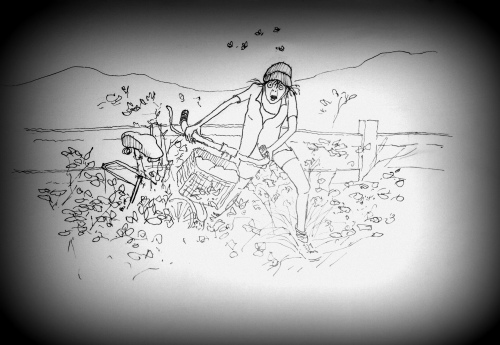
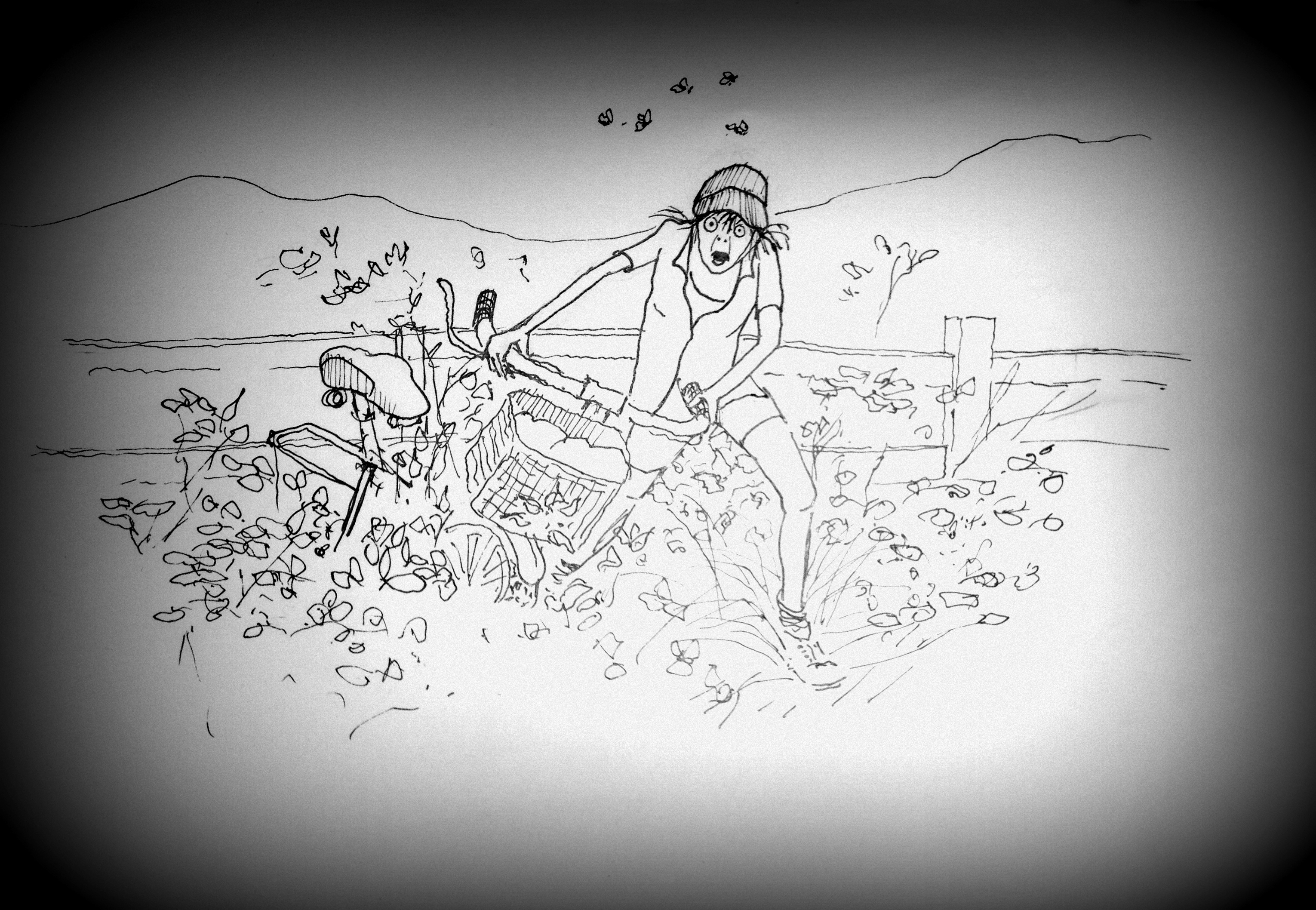
Me dragging my crippled bike into what I thought was safe territory.

Me dragging my crippled bike into what I thought was safe territory. [E. Colin Williams]

I had emerged into an open meadow. The rich green spring grasses were soaked after the earlier rain. White dots moved about in the field and I realized with glee that I had wound up in a sheep field! This was a great sign, for surely where there were sheep there would be a shepherd. And, where there was a shepherd, surely there would be a screwdriver!

I started dragging the bike across the field and soon spotted a gate way over on the far side. I was making my way toward this promising destination when the sheep spotted me.

I had always been under the impression that sheep are sweet, docile creatures that travel in groups and generally try to stay out of trouble. This might be true of ewes and lambs, but it is most certainly not true of a ram who believes his ladies are in peril.

The ram, who sported a pair of impressive horns, took one look at me dragging my broken bike across his field and decided I was clearly up to no good. He lowered his head, took aim, and charged. I managed to get the bike between me and the charging beast, The impact as he battered the bike was impressive. I staggered backwards, still holding the bike in front of me. I yelled and tried to make myself look fierce while stumbling toward the gate, fending off the crazed ram with kicks and arm waves and strings of expletives not at all appropriate for a young woman.
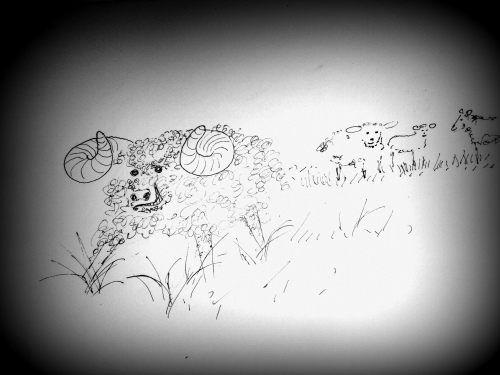
Never underestimate the fury of a ram protecting his girls.

Never underestimate the fury of a ram protecting his girls. [E. Colin Williams]

Somehow I managed to get myself and the bike through the gate where I collapsed in the grass, gasping for breath.

Which is where the farmer found me. He looked completely baffled to see me there, by now leaning up against his gate post.

“Where did you come from, lass?”

“Through your sheep field.”

“But… there’s nothing up that way. And you had to come past Jock?”

I nodded.

“Best you come inside and have a cup of tea with my wife.”

Given I was about to expire with starvation, I agreed. And, while I enjoyed a lovely cup of tea and a warm scone with cream and preserves in the farmhouse, the kind farmer fixed my bike.

Before long, I was back on my way with instructions as to how to get back to the main road. Several hours after I had taken my detour, I spotted a little sign off to the side of the road, “This path rejoins the road farther on.” Doggedly, I pedaled right on past.

Sometimes the road less travelled is less travelled for a reason!

NABLOPOMO – From Squash Hauler to Ambulance – Love my Multi-purpose Cart!

Around here we do a lot of improvising (stay tuned for a post about what we are doing with a garbage can and a roofing nail… experiment currently under way in the laundry sink…).

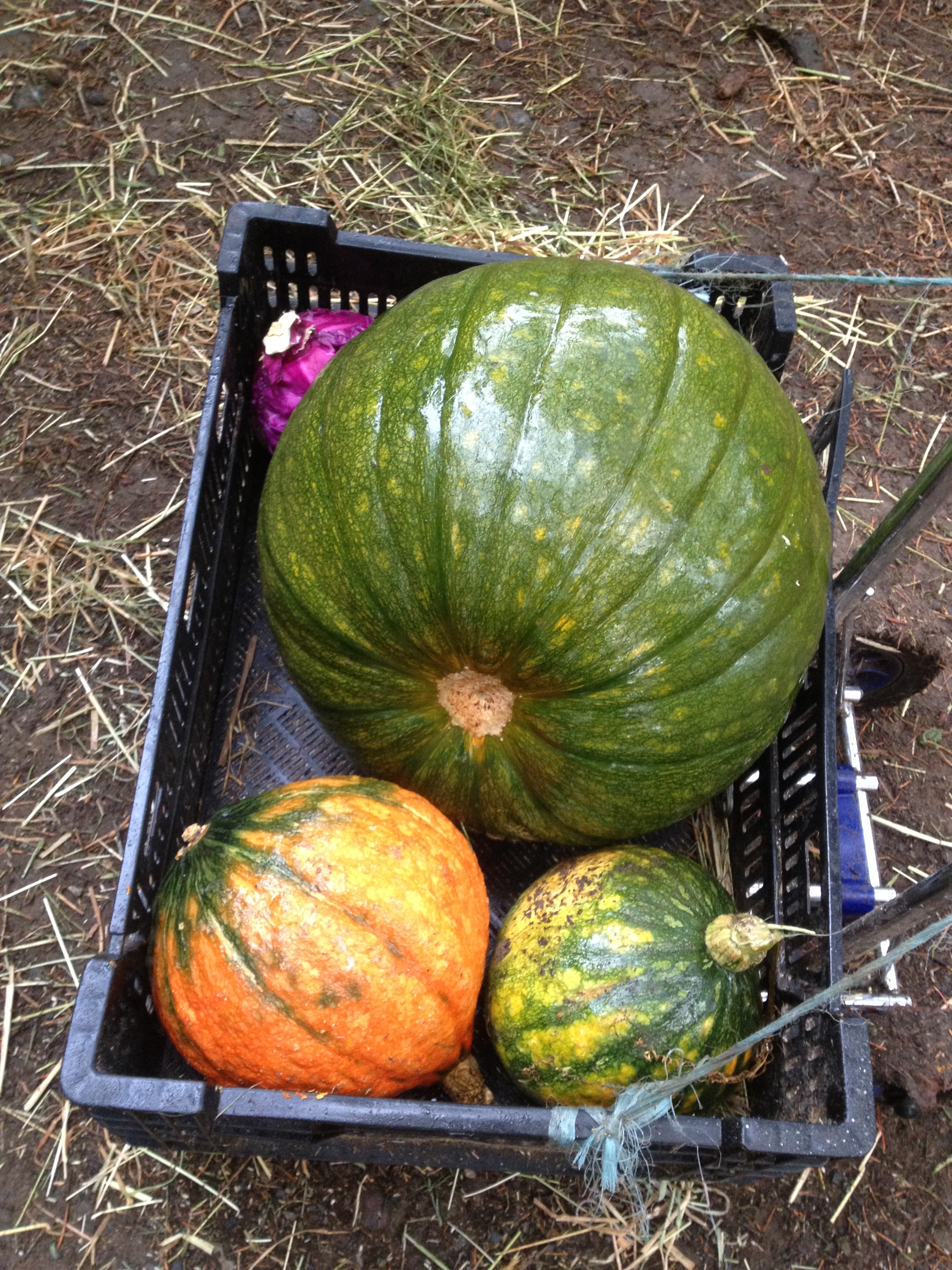
And, I also do a lot of schlepping. With my critters living in various locations up and down the road, I am constantly hauling loads of feed from one place to another. I had been improvising with one of those folding luggage carts onto which I had fastened (with bungee cords and binder twine) a sturdy plastic vegetable crate. I don’t have a great photo, though here it is in use hauling pumpkins and squash from the neighbor’s place up to the pigs.

Cart and Squash

The capacity was a bit limited and on uneven terrain, the whole contraption was very tippy. The handle also tended to collapse at the most inopportune of moments. Worst disaster with this unit occurred when I foolishly tied the dogs to the handle and stopped to pick up a broken bottle from the road. Mistake! The dogs spotted a squirrel and took off, scattering buckets, grain, carrots, and hay all over the road. They terrified themselves when they realized the clattering disaster was chasing after them and tried to flee into the brush. The whole dreadful incident ended with the dogs cowering in the ditch and me standing in the middle of the road with my mouth open, still holding the broken bottle.

For larger loads, the wheelbarrow came in handy.

Lunch CartThis worked ok here at our place (and, as long as I didn’t tie the dogs to it), but wasn’t so good going up the hill and along the road to where I keep the turkeys, mostly because I never did figure out a good way to deal with frolicking dogs, laden wheelbarrow, and the hill all at the same time.

Wheelbarrows have also come in handy during the annual winter schlepp of water containers down the hill…

Winter at Dark Creek FarmRecently, I procured a new schlepping device, a garden cart that is quite stable, has plenty of capacity, and can be dragged along behind the frolicking dogs.

Garden CartThis has also proven handy during the recent cold snap for hauling water (I can get more into the cart than I can into the wheelbarrow).

IMG_6934-001

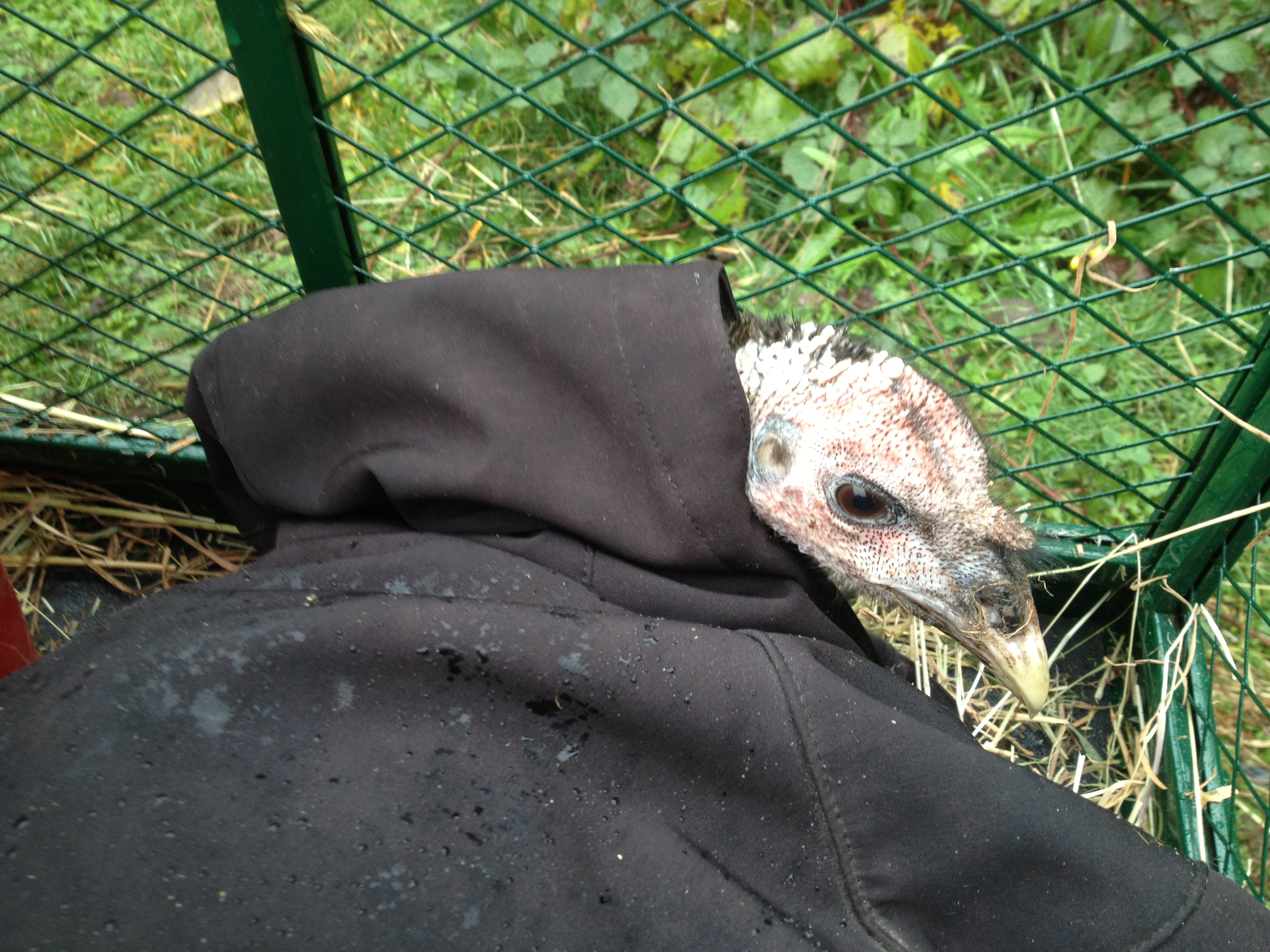
What I hadn’t anticipated was it’s usefulness as an ambulance for a turkey who was a bit under the weather.

Look closely at the thing that’s wrapped in my coat behind the empty feed buckets…

IMG_6935After a few days of TLC up at the turkey spa, the patient recovered fully and rejoined the flock.

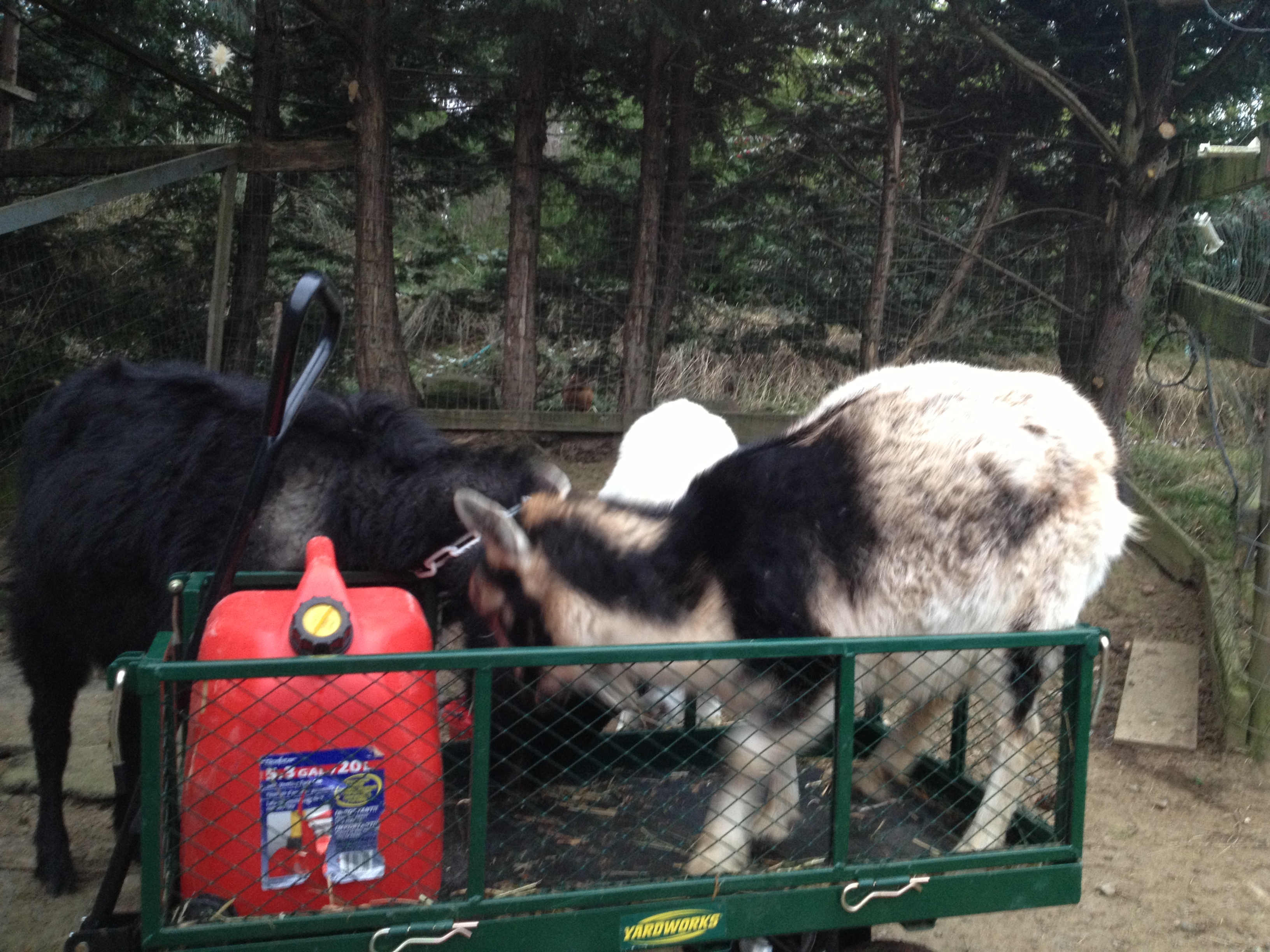
The other thing that I found a bit surprising was how challenging it was going to be to navigate my way through the goat pen with the cart. I know better than to attempt such a maneuver with goodies in the cart, but coming down through the goat pen with a couple of water jugs shouldn’t have been a problem. Those goats can sniff out a spilled morsel of any sort of grain or seed or fleck of carrot from fifty paces. They charge the cart and surround it, oblivious to my shouts and threats.

The goats swarming the cart in search of spilled treats...

The goats swarming the cart in search of spilled treats…

Electra is a bit on the short side, so her solution is to jump right in, all the better to sniff around and lick up anything that might be lickable.

So far, the cart has proven to be worth every penny and probably gets used more than any other single item on the farm. If only all my tools were so darned satisfying…